
Why Playing It Safe Is the Riskiest Decision You’ll Ever Make
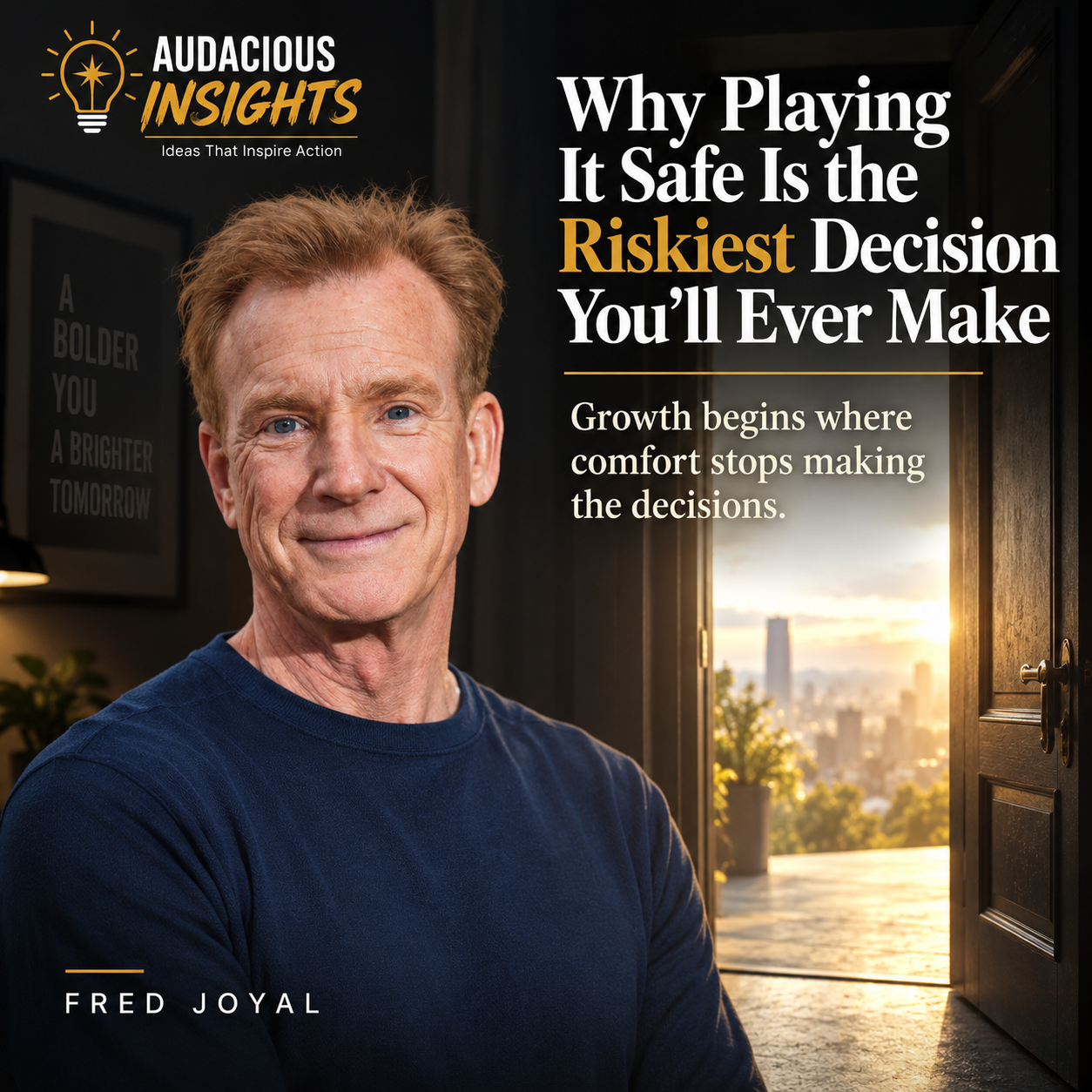
Playing it safe rarely feels dangerous.
That is precisely why it can be.
There is no dramatic alarm when comfort begins limiting us. Nothing necessarily goes wrong. We keep the job. Avoid the awkward conversation. Decline the opportunity we're not certain we can handle. Wait until we're more confident. Stick with what we already know.
Each individual decision can feel perfectly reasonable.
The danger emerges when those decisions become a pattern.
Fred Joyal understands that pattern because he lived it. Before becoming a longtime entrepreneur and building 1-800-DENTIST into a business with hundreds of employees, Fred describes himself as a painfully introverted person who assumed bold people simply possessed something he didn't.
His experience eventually taught him something very different: boldness can be learned.
More importantly, it can be practised.
Why This Topic Matters
We often think about risk in terms of what might happen if we act.
What if I fail?
What if I embarrass myself?
What if they say no?
What if the business doesn't work?
What if I speak up and people disagree?
Those are legitimate possibilities. Yet there is another form of risk we tend to calculate far less carefully: what happens if we continually don't act?
Fred puts the tension plainly: “If you're comfortable 100% of the time, if you're playing it safe all the time, you're steadily falling backwards.”
That doesn't mean we should recklessly pursue every impulse. It means comfort cannot be the sole measure we use to determine whether something is worth doing.
A life built entirely around avoiding discomfort eventually has a cost.
Opportunities pass. Conversations never happen. Ideas remain unexplored. Confidence stays undeveloped because we never give ourselves the experiences required to build it.
Safety can protect us from failure.
It can also protect us from growth.
Comfort Is Not the Same as Progress
One of Fred's most useful comparisons is physical exercise.
When we train a muscle, growth doesn't happen because everything feels easy. We deliberately create resistance. We work toward the point where the muscle is challenged.
Fred notes that in exercise, we sometimes deliberately aim for the repetition we cannot complete. Failure isn't evidence that the workout went wrong. It is part of what makes the workout productive.
Yet we often apply the opposite logic to the rest of life.
We assume discomfort means something is wrong.
A difficult conversation feels uncomfortable, so we postpone it. Walking into a room where we don't know anyone feels uncomfortable, so we stay home. Applying for a position that feels slightly beyond us creates uncertainty, so we wait until we feel qualified enough.
The problem is that our comfort zone then becomes less like a place to recover and more like a boundary we refuse to cross.
Fred's own transformation began when he started doing things that made him uncomfortable. The result wasn't that discomfort disappeared. His capacity to handle it expanded.
That distinction matters.
Growth isn't necessarily about becoming fearless. It is about becoming increasingly capable of moving while uncertainty is still present.
Confidence Usually Comes After the Action
One of the easiest traps is waiting for confidence before doing something bold.
Fred challenges that sequence.
“If you're confident, it doesn't require boldness,” he explains. “Boldness builds your confidence.”
That reverses the way many of us think about personal growth.
We tell ourselves we'll speak when we're more confident. We'll launch when we're more confident. We'll introduce ourselves when we're more confident. We'll make the ask when we're more confident.
Yet where is that confidence supposed to come from?
Usually, experience.
Fred recommends deliberately creating small experiences of discomfort when the consequences are low. Talk to a stranger. Try something unfamiliar. Put yourself in situations where the outcome isn't guaranteed but failure carries little meaningful cost.
Those moments become repetitions.
The objective isn't to become reckless. It is to build evidence that discomfort is survivable.
Eventually, that evidence changes how we respond when the stakes are higher. Instead of automatically retreating when an important opportunity appears, we have developed a different reflex.
Speak up.
Say yes.
Take the shot.
Confidence becomes the result of bold action rather than its prerequisite.
The Cost of Hesitation Compounds
Fred's relationship with boldness wasn't born from a single triumphant moment. He describes something much less glamorous: accumulated regret.
He remembered opportunities he had missed because he hesitated. He didn't say yes. He held himself back. Those decisions stayed with him.
Eventually, he decided the pattern had to end.
Later, while working in advertising, Fred began presenting creative work to clients with increasing enthusiasm. His boldness started producing positive results. His bosses wanted him in meetings. Clients responded to his conviction.
The very behaviour he had once been reluctant to embrace was now being rewarded.
That created a powerful feedback loop.
Fred describes what happened next in an especially revealing way: “I didn't become a different person. I became the full me.”
That may be one of the most important distinctions in this entire conversation.
Boldness isn't necessarily about becoming louder, more extroverted or more attention-seeking. It can simply mean removing some of the restrictions we've placed on ourselves.
The risk of chronic hesitation isn't only that we miss individual opportunities. Over time, we may begin constructing a smaller version of our lives around what feels safe.
Fred asks people to consider not merely what failure might feel like, but what the regret of never trying might feel like.
That's a very different calculation.
Practise Discomfort Before You Need Courage
If boldness is a skill, it can be trained.
Fred compares the process to building muscle. You don't walk into a gym for the first time and attempt the heaviest weight available. You begin where you are and progressively increase the challenge.
The same principle can apply to courage.
Fred encourages people to do something uncomfortable every day when the stakes are low and the consequences are minimal.
The purpose isn't discomfort for discomfort's sake.
It is preparation.
A small act of everyday bravery teaches your brain that uncertainty doesn't automatically equal danger. It gives you practice moving before you know exactly how things will turn out.
That matters because life's biggest opportunities rarely arrive after we've achieved perfect certainty.
The conversation may need to happen now.
The opportunity may have an expiry date.
The idea may require action before every variable has been resolved.
The moment may simply require us to decide whether we're going to step forward or stop ourselves again.
Fred poses a challenging question: Who stops you the most?
His answer is often ourselves.
That realization can be uncomfortable, but it is also empowering. If some of the barriers are internal, we have the ability to begin changing them.
Lessons for Living Audaciously
Living audaciously doesn't require making the biggest possible gamble.
Sometimes it means making one slightly bolder choice than you made yesterday.
Start the conversation.
Raise your hand.
Ask the question.
Apply for the opportunity.
Introduce yourself.
Try the thing you're probably going to be mediocre at initially.
Allow yourself to discover what happens rather than deciding in advance what cannot happen.
Fred's journey from painful introversion to entrepreneurship, speaking and teaching boldness illustrates what can happen when discomfort becomes something to engage with rather than automatically escape.
He doesn't argue that every risk succeeds. His own entrepreneurial journey included mistakes, uncertainty and experiments that didn't work.
The point is not to eliminate failure.
The point is to stop allowing the possibility of failure to make every important decision for us.
Because playing it safe has consequences too.
Fred eventually arrived at a place where, as he puts it, “trying and failing feels better than not trying.”
That is a powerful standard for an audacious life.
We don't need certainty that everything will work.
We need enough courage to discover what could.
Listen to the full conversation with Fred Joyal on The Audacious Living Podcast for more on building boldness, embracing discomfort and refusing to stack regrets. Subscribe to the podcast, share this insight with someone who may be standing at their own threshold, and follow The Audacious Living Podcast for more conversations about what it means to live life audaciously.
