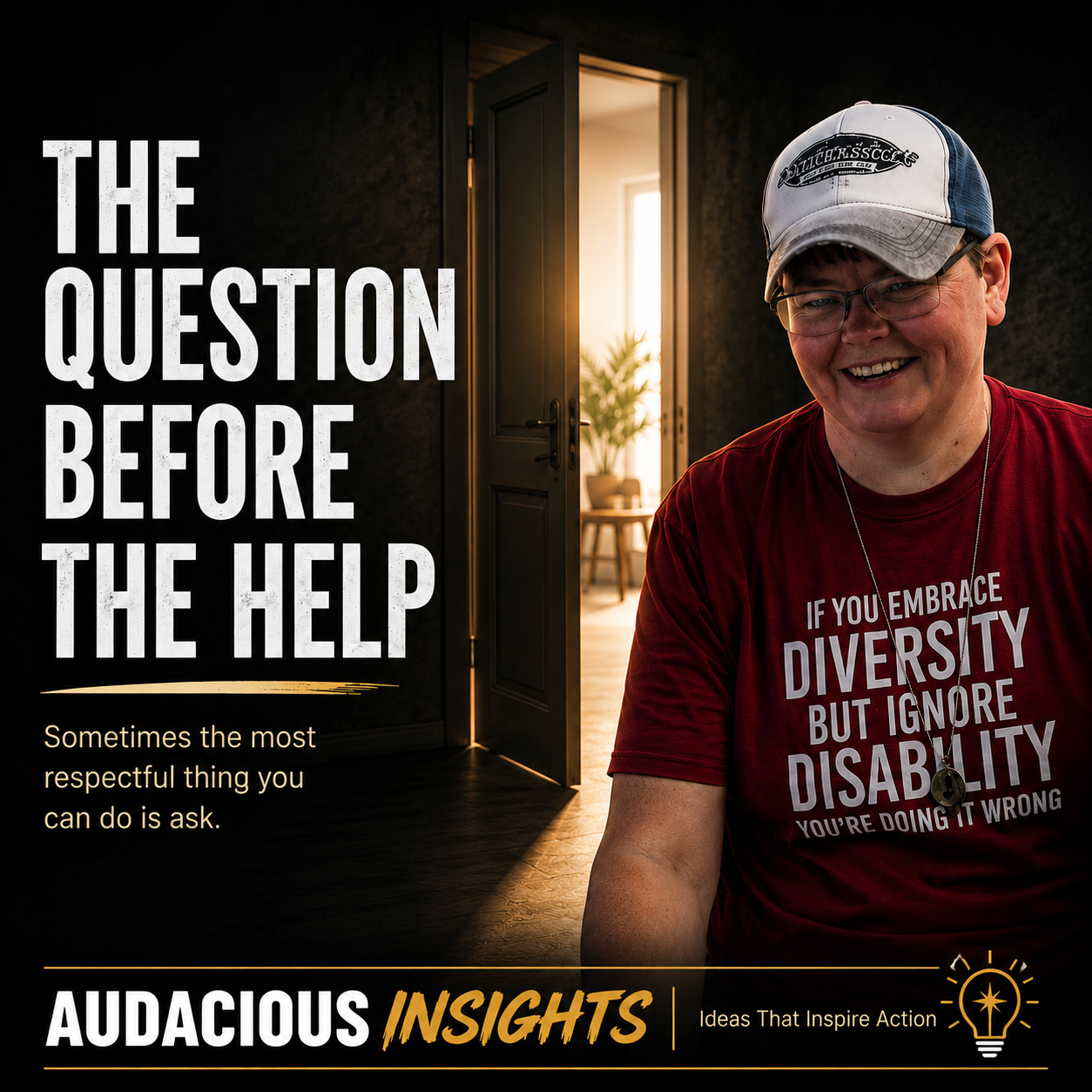
The Question Before the Help
Helping seems straightforward.
Someone appears to need something, we recognize an opportunity to make life easier, and our instinct is to act. It feels generous. It may even feel obvious.
Yet there is a small but important question that can get lost between noticing a need and trying to solve it:
What would actually help?
That question became increasingly significant as I listened to Jenna Udenberg talk about accessibility, disability inclusion and the complicated act of asking for help.
Jenna has used a manual wheelchair since she was eight, after being diagnosed with juvenile arthritis at seven. She later spent 19 years as a music educator and now leads Above and Beyond With U, a Minnesota nonprofit focused on increasing physical and attitudinal accessibility and inclusion.
Her experience makes one thing clear: helping isn't simply about what we are willing to give.
It is also about whether we have taken the time to understand what is actually needed.
Why This Topic Matters
Most of us want to believe we would help another person when given the opportunity.
The problem isn't necessarily our intention. It is what can happen when intention moves faster than understanding.
We see a situation. We interpret it through our own experience. We decide what would make things better. Then we act.
Sometimes we get it right.
Sometimes we unintentionally make ourselves the author of someone else's solution.
That tension becomes particularly visible when we talk about accessibility. Jenna's experiences span a period in which physical access, social attitudes and legal protections around disability have changed considerably. She remembers growing up in a home that initially wasn't accessible to her wheelchair. Her family had to manoeuvre her up and down four stairs until a window was eventually replaced with a door and ramp, an adaptation she describes as changing everything.
Yet physical access represents only part of the story.
Jenna's work today is concerned with both physical and attitudinal accessibility.
That distinction matters because we can modify a building without changing the assumptions of the people inside it.
A ramp can create access to a room.
A conversation can create access to belonging.
The second requires something more from us.
It requires listening.
Good Intentions Don't Automatically Create Good Help
There is something wonderfully human about wanting to jump in.
Someone is struggling. We want to fix it.
Yet good intentions can still produce the wrong solution when we haven't understood the problem.
Jenna described asking for help in a way that complicates the usual idea of simply speaking up:
“Sometimes you just ask for help with the symptoms and not ask for help with the root of things.”
That's worth sitting with.
We do this far beyond disability.
A colleague appears overwhelmed, so we take something off their plate without asking which responsibility is actually creating the pressure.
Someone we care about is struggling, so we offer advice when what they really wanted was to be heard.
A leader sees a performance problem and introduces another process when the real problem is that employees don't feel safe enough to explain what's wrong.
The impulse to help isn't the problem.
The assumption is.
There is a meaningful difference between asking, “How can I help?” and deciding, “Here's what you need.”
One centres our solution.
The other creates room for someone else's voice.
Asking Is More Complicated Than It Looks
One of the most interesting things Jenna said was that living audaciously, for her, means “learning to not be afraid to ask.”
At first, that might sound surprising coming from someone who has had to ask others for assistance throughout much of her life.
Yet Jenna explained that meaningful asking involves more than simply requesting help. You have to understand the root of the need. You have to consider whether you're asking someone with the appropriate skill or available time. There is also another factor that is harder to measure: whether the person authentically wants to help.
That turns asking into a relationship rather than a transaction.
There is vulnerability on one side and responsibility on the other.
The person asking has to communicate.
The person receiving the request has to listen without immediately imposing their own interpretation.
Both people have to recognize that saying what you need isn't weakness and admitting you don't know what someone needs isn't incompetence.
That last part may be particularly difficult.
We like having answers.
Asking requires us to acknowledge that another person is the expert on an experience we haven't lived.
That takes humility.
Inclusion Changes When Needs Stop Being “Special”
Jenna described an audacious, fully inclusive world as one in which authentic communication allows her needs to stop being viewed as “special” while everyone else's are treated as typical.
Her point wasn't that everyone requires identical treatment.
Quite the opposite.
People's needs may “look different,” “function different” or “act different.” What matters is creating environments where those differences don't prevent people from participating in ordinary life.
This changes the conversation.
Instead of asking why one person requires something different, we can ask whether the environment was designed with enough people in mind to begin with.
Think about how many things we already customize without considering them special.
We adjust the temperature.
We change the brightness on a screen.
We choose whether captions are turned on.
We move a chair.
We change how we communicate with different people.
We recognize that different circumstances require different responses every day.
Inclusion asks us to extend that same thinking more deliberately.
It doesn't require us to anticipate every possible need.
It requires us to create enough openness that people can tell us what we've missed.
Leave Room for the Other Person's Voice
Jenna shared a philosophy from her upbringing that has stayed with her: leave spaces better than you found them.
Over time, she expanded it.
She now wants to leave people in better places than she found them, while hoping they will do the same for her.
There is reciprocity in that idea that I appreciate.
It isn't one person arriving as the helper and another being reduced to the person who needs help.
Both people have something to contribute.
That is also reflected in the name of Jenna's organization, Above and Beyond With U. She emphasized the importance of the word “with.” Her approach isn't to arrive, deliver an isolated solution and disappear. She wants relationships where people learn and experience those “aha moments” together.
That one word changes a lot.
Doing something for someone can be generous.
Doing something with someone preserves their participation in what happens next.
Sometimes the best help is action.
Sometimes it's advocacy.
Sometimes it's removing a barrier.
Sometimes it's listening.
You cannot reliably know which one is needed until the person affected has a voice in the answer.
Lessons for Living Audaciously
We often associate audacity with speaking loudly, taking risks or charging into uncertainty.
There is another form of audacity that is much quieter.
Ask before you assume.
That may mean asking for the help you genuinely need rather than struggling silently.
It may mean asking another person what support would actually be useful instead of deciding for them.
It may mean questioning a system that technically meets a requirement but still doesn't work particularly well for the human beings using it.
Jenna has done that too.
She recalled returning from leadership training and speaking directly to community leaders about how disabled students and their families had been treated. She remembered telling them, “we will treat our families better than my family was treated.”
Later in our conversation, she distilled the responsibility behind that conviction beautifully:
“We know better, so now we need to do better.”
Living audaciously sometimes begins right there.
Not with knowing everything.
Not with having the perfect solution.
With being willing to recognize what we don't know, asking the person who does, and allowing the answer to influence what happens next.
Maybe the question before the help isn't complicated after all.
What would actually help?
Then comes the part that matters most.
Listen to the answer.
To hear Jenna Udenberg share more about accessibility, asking for help, relationships, advocacy and building a more inclusive world, listen to the complete conversation on The Audacious Living Podcast. Subscribe to the show, follow along for future conversations, and if this article made you reconsider what meaningful help looks like, share it with someone who might appreciate the question too.
