
Why Every Leader Needs a Framework Before Taking the Next Bold Step
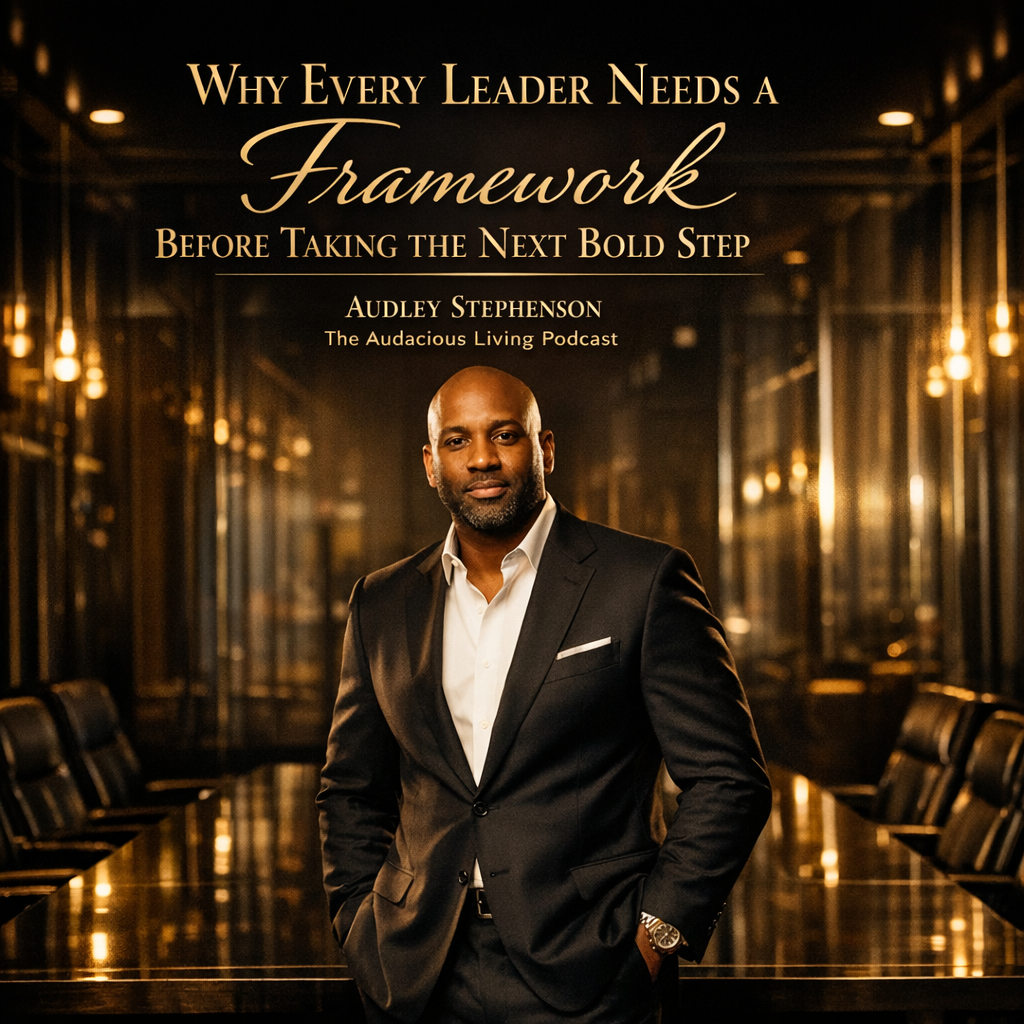
Explore how leadership frameworks provide clarity, consistency, and confidence when navigating uncertainty.
Leadership can look impressive from the outside. Titles, responsibilities, influence, visibility. But one of the strongest reminders from my conversation with Amos Balango on The Audacious Living Podcast is that leadership is not really about position. It is about trust, communication, humility, and the ability to guide people well when things get difficult.
That is what makes a framework so important.
In our conversation, Amos kept coming back to the idea that leaders need something solid to return to when the pressure rises, when doubt creeps in, or when circumstances start pulling them in different directions. A framework becomes a kind of compass. It keeps you grounded in what matters most.
These insights come from a conversation on The Audacious Living Podcast with Audley Stephenson, which you can listen here.
Why This Topic Matters
A lot of people think leadership begins when you get the title. Amos challenged that idea completely.
He made it clear that leadership starts much earlier than that. It starts in how you communicate. It starts in the value you add. It starts in whether people can trust you. And it definitely starts in how well you understand yourself.
That matters because many people are trying to lead while reacting to everything around them. They are moving from pressure to pressure, problem to problem, and opinion to opinion without any clear anchor. That is exhausting. It is also dangerous, because when you do not have a framework, you can be pulled off course by every challenge that shows up.
A framework gives leaders a way to stay aligned. It helps them make better decisions. It reminds them who they are, what they stand for, and where they are trying to go.
In other words, it helps them lead on purpose instead of by accident.
Insights from the Conversation
One of the most powerful ideas Amos shared was that we have moved from positional leadership to influential leadership. In the past, leadership often looked like command and control. People followed because of hierarchy. But today, people want more than direction. They want clarity. They want honesty. They want to know whether the person leading them can actually be trusted.
That shift changes everything.
It means leaders cannot rely on title alone. They have to communicate in a way that people understand. They have to be able to simplify complex ideas so others can act on them. Amos gave a great example of how strong leaders can take something complicated and break it down into language that moves people forward. That kind of clarity is not a bonus. It is essential.
Another important insight from the conversation was Amos’s emphasis on humility and teachability. He spoke about the danger of leaders believing they already have all the answers. That mindset can quietly shut down growth. And when a leader stops growing, the people around them often feel it too.
That point really stood out to me.
Leadership is not about arriving at some final destination where you know everything. It is a journey. It requires reflection. It requires adjustment. It requires enough humility to admit when something needs to change.
Amos also talked about how leaders need to think ahead. They are not there for the easy moments. They are there for the turbulent ones. A strong leader anticipates challenges, prepares for setbacks, and helps others move through uncertainty with purpose. That is another reason a framework matters. When turbulence shows up, it gives you something steady to come back to.
Featured Insight from the Conversation
“If you’re taking a walk and nobody’s following, that’s a lonely road.”
— Amos Balango
Lessons for Living Audaciously
Living audaciously is not about being reckless. It is not about making noise just to be noticed. It is about moving with intention, courage, and alignment.
That is why this conversation connects so naturally with the idea of audacious living.
A leader with a framework is not just reacting. They are choosing. They are grounded enough to stay true to what matters. They are reflective enough to keep growing. And they are humble enough to recognize that leadership is always about people, not ego.
There is also something deeply audacious about choosing influence over control. About choosing clarity over complexity. About choosing trust over title.
That kind of leadership invites us to do the same in our own lives.
We may not all have a formal leadership role, but every one of us influences someone. The question is whether we are doing that intentionally. Are we adding value? Are we leading by example? Are we communicating in a way that helps others move forward?
Those are not small questions. They are life-shaping ones.
Closing Reflection
The next bold step in leadership is not always louder. Sometimes it is deeper.
Sometimes it is the quiet decision to become more grounded, more teachable, and more intentional about how you lead yourself and others.
And maybe that is where real audacity begins, not in having all the answers, but in building a framework strong enough to keep moving when the path gets uncertain.
This insight comes from a powerful episode of The Audacious Living Podcast with Audley Stephenson, where conversations explore leadership, resilience, and what it means to live audaciously.
🎧 Listen to the full episode here:
Learn more about the work of Amos Balango here.
