
Why You Should Choose Hard Things Before Life Chooses Them for You
Most of us don't schedule adversity.
We don't put setbacks on the calendar, reserve an afternoon for uncertainty or wake up hoping something will test our ability to cope. Difficulty tends to arrive on its own timetable, often without warning and rarely when we feel completely prepared.
That creates an interesting question: What if resilience isn't something we have to wait for life to test?
What if we can train it?
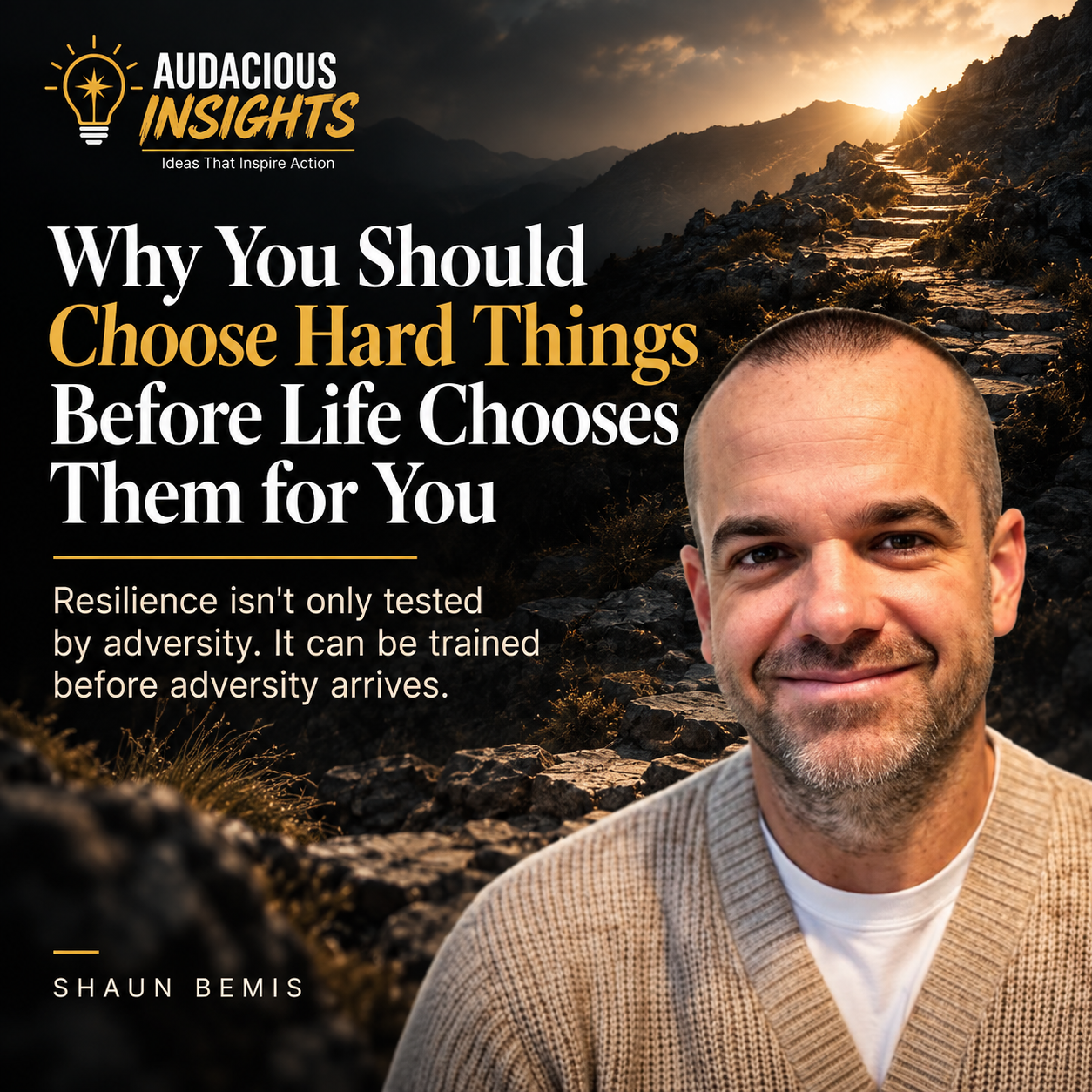
That idea sits at the heart of my conversation with Shaun Bemis, a 20-year Navy veteran whose career included supporting Navy SEAL teams and who later found another testing ground in endurance athletics. For Shaun, deliberately doing difficult things isn't about proving how tough he is. It is a way of building evidence that when something difficult eventually arrives, he has been here before.
Not in the exact circumstances, perhaps. But in the feeling.
The discomfort. The uncertainty. The temptation to stop. The moment when the original plan no longer works.
Those are things we can practise.
Why This Topic Matters
We often talk about resilience retrospectively.
Something happens. We struggle. We adapt. Eventually, we look back and realize we were stronger than we thought.
There is value in that. Yet it leaves resilience dependent on circumstances giving us an opportunity to discover it.
Shaun offers a different approach.
Instead of waiting for life to create the test, deliberately create manageable tests of your own.
That doesn't mean manufacturing unnecessary suffering or making life difficult simply for the sake of difficulty. It means choosing meaningful challenges that stretch your current capabilities.
Shaun found one version of that through ultra running. Near the end of his Navy career, he discovered running despite never considering himself much of a runner. Eventually, that developed into ultra marathons, including a 100-kilometre race that took him roughly 18 hours to complete.
The distances matter less than what those experiences gave him.
When another part of life becomes difficult, he has something concrete to remember: if I could work through that, perhaps I can work through this.
That is resilience becoming proactive rather than reactive.
Difficulty Can Become a Training Ground
One of Shaun's most revealing observations came from something relatively ordinary: beginning a workday after a demanding run.
During a business trip to Barcelona, he planned a run through the city and up toward an Olympic complex. Living in Miami meant he wasn't accustomed to significant elevation, so the climb was genuinely difficult.
Then he went to work.
Suddenly, the problems waiting for him there felt different.
He had already spent part of the morning asking his body and mind to continue when things were uncomfortable. A challenging business problem did not disappear, but his relationship to it had changed.
As Shaun put it, intentionally doing hard things made other difficulties feel easier than simply “waiting for hard things to happen to you that you have to deal” with.
That distinction matters.
Chosen difficulty gives us a relatively controlled environment in which to practise our response.
We learn what happens when we're tired. We discover what our internal dialogue sounds like when something becomes uncomfortable. We notice whether our first instinct is to quit, panic, become frustrated or find another approach.
Then we get another opportunity to practise.
Resilience begins becoming familiar.
Preparation Is Usually Less Dramatic Than We Imagine
Shaun's military experience reinforced another important part of this idea.
When people imagine elite military preparation, they may picture sophisticated exercises and extraordinary skills. Shaun described something much less glamorous: repetition of the basics.
He recalled watching SEALs repeatedly practise fundamental movements until those actions became almost automatic. Regardless of experience or previous deployments, preparation returned to foundational skills.
The principle was simple: be brilliant at the basics.
That matters because preparation for life's difficult moments often looks ordinary too.
It may be keeping a commitment when motivation disappears. Having a difficult conversation instead of avoiding it. Trying something you're not certain you can accomplish. Asking for feedback you'd rather not hear. Exercising when you'd prefer to remain comfortable. Learning a skill slowly enough to become competent rather than rushing toward the appearance of competence.
None of those moments necessarily feels heroic.
That's the point.
We build capacity in ordinary moments so that we have something available when extraordinary moments arrive.
Hard Things Teach You to Adjust, Not Just Endure
There is another misconception about resilience: that it means stubbornly sticking with something no matter what happens.
Shaun's experience suggests almost the opposite.
Endurance racing requires planning, but it also guarantees that parts of the plan will fail.
Nutrition may stop working. Your stomach may rebel. Conditions may change. Fatigue may arrive earlier than expected. What looked perfectly sensible before the race may become useless halfway through it.
The skill isn't simply enduring the original plan.
It is adapting without abandoning the objective.
Shaun connects that directly to his military background. After operations and exercises, teams conducted after-action reviews: What worked? What didn't? What did we learn? What should change next time?
He applies the same process to his races.
Over time, problems that once regularly derailed him became more manageable because he didn't merely survive them. He studied them and changed his approach.
That's an important distinction for everyday resilience.
Difficulty becomes useful when we learn from it.
Choosing hard things gives us repeated opportunities to discover where our assumptions fail, make adjustments and try again. We aren't simply increasing our tolerance for discomfort. We're improving our ability to respond intelligently inside it.
Challenge Doesn't Require Making Your Whole Life Miserable
There is an important boundary here.
Choosing hard things should not become a philosophy of constant suffering.
Shaun is remarkably clear about that.
He could train more aggressively. He could skip ice cream with his children to improve his fitness. He could structure every part of his life around becoming a faster endurance athlete.
He chooses not to.
He wants to pursue difficult goals while still enjoying his life.
That may be one of the most useful parts of his perspective because the idea of “doing hard things” can easily become another version of hustle culture: wake up earlier, work longer, sacrifice more, prove you're tougher than everyone else.
Shaun's version is different.
During a Christmas vacation, he had planned a demanding run in the mountains. When his wife told him she hadn't slept well and wanted him nearby, he abandoned the workout and got back into bed.
The goal mattered.
His relationship mattered more in that moment.
Resilience shouldn't make our lives smaller. Ideally, it gives us greater capacity to participate in them.
The purpose of choosing difficulty isn't to worship difficulty. It is to become better equipped for the things that genuinely matter.
Confidence Is Evidence You Can Carry Forward
There is something powerful about completing something you weren't certain you could do.
You now possess evidence.
The next challenge may have nothing to do with the previous one. A long run won't teach you how to solve every business problem. A difficult workout won't prepare you for every personal setback.
Yet the internal evidence transfers.
You know what it feels like to want to stop and continue anyway.
You know what it feels like when the original plan fails and you find another way.
You know what it feels like to discover that your perceived limit wasn't necessarily your actual limit.
Shaun's endurance experiences give him that reference point. When something difficult appears elsewhere in his life, he can look backwards and remind himself that he has already navigated discomfort, uncertainty and fatigue.
We can all create our own versions of that evidence.
Your hard thing doesn't need to be an ultra marathon.
It simply needs to require something from you that comfort doesn't.
Lessons for Living Audaciously
Audacity isn't always a giant leap.
Sometimes it is deliberately moving toward something difficult when you could comfortably avoid it.
Choose the conversation you've been postponing.
Set the goal that makes you uncertain whether you can reach it.
Learn something that forces you to become a beginner again.
Ask for the feedback that might challenge the story you've been telling yourself.
Take on a physical, creative, professional or personal challenge that requires preparation, patience and adaptation.
Then pay attention to who you become while doing it.
The objective isn't to eliminate fear, discomfort or uncertainty. It is to develop a different relationship with them.
Life will eventually choose hard things for all of us.
We don't control when they arrive or what form they take.
We can control whether difficulty is completely unfamiliar when it gets here.
Choosing meaningful challenges today can give us something valuable for tomorrow: evidence that we can enter discomfort, adjust when necessary and keep moving forward.
Left foot. Right foot.
Forward.
Listen to the full conversation with Shaun Bemis on The Audacious Living Podcast for more on resilience, leadership, planning and what endurance can teach us about navigating life and work. Subscribe to the podcast, follow along for more Audacious Insights, and share this article or episode with someone who may be ready to choose their next hard thing.
