
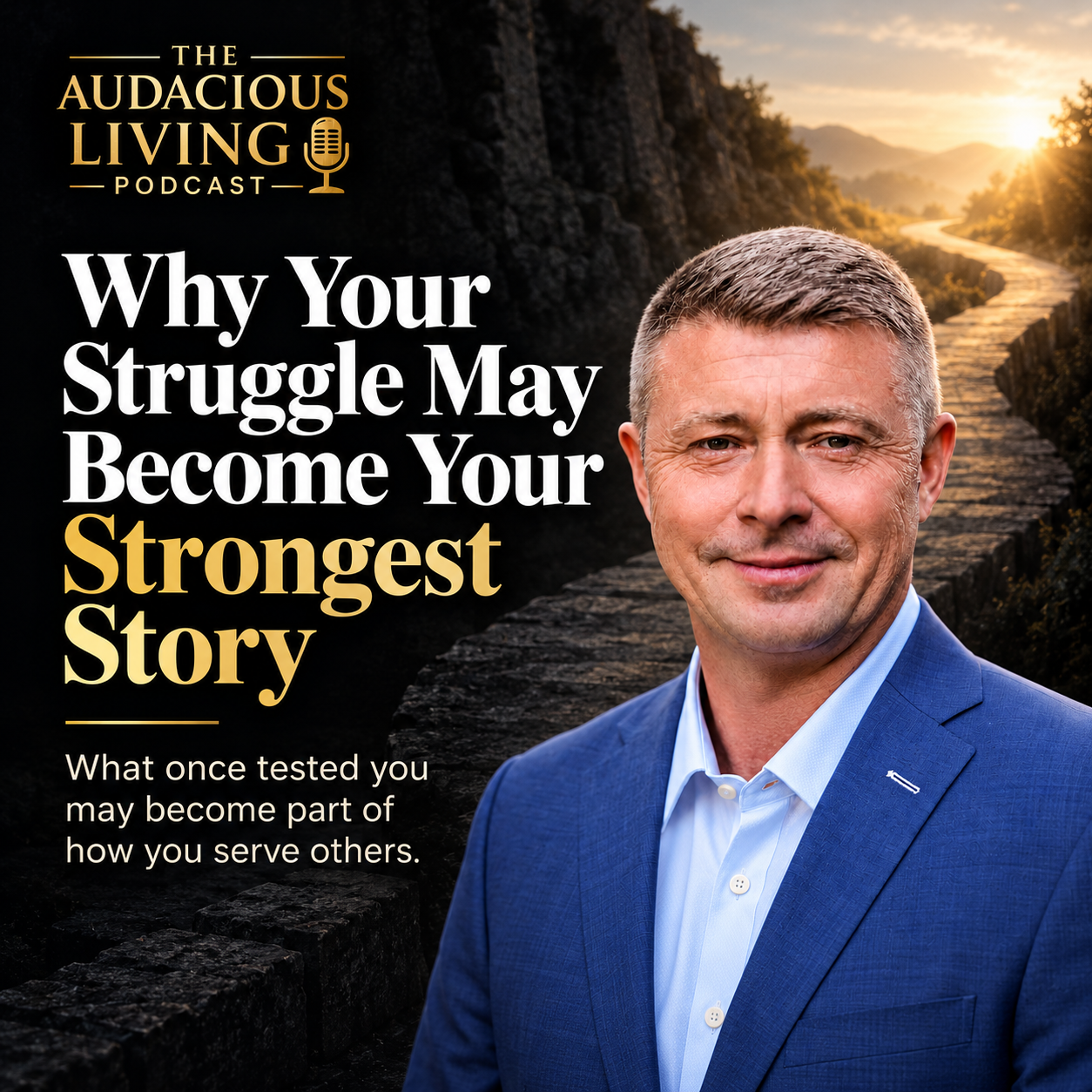
Why Your Struggle May Become Your Strongest Story
There are chapters of life we would never choose to live twice.
They may contain failure, addiction, loss, uncertainty, regret or decisions we wish we could undo. While we are living through them, the goal is usually simple: get through this. Make it stop. Find a way to the other side.
Time can give those experiences a different meaning.
Not because the pain suddenly becomes good. Not because suffering should be romanticized. Rather, distance sometimes allows us to see that what happened to us also shaped what we learned, what we understand and what we may now be uniquely equipped to give to someone else.
Pax Prentiss knows something about that transformation.
Before co-founding Passages Malibu, Pax spent 10 years addicted to heroin, cocaine and alcohol. He described periods of profound suffering, including being beaten and hospitalized while trying to obtain drugs.
Yet the story he tells today is not simply about what addiction took from him.
It is also about what happened when he began asking why, discovered a purpose and eventually used an extraordinarily difficult chapter of his life to help other people reclaim theirs.
Why This Topic Matters
We often judge difficult chapters while we are still inside them.
We call them wasted years. Wrong turns. Failures. Evidence that we should have known better.
That reaction is understandable. Nobody needs to pretend a painful experience wasn't painful.
Yet regret can become another place in which we get stuck.
Pax described asking himself whether he lives with regret about his past. His answer reveals an important distinction between accepting what happened and approving of it.
“You know, I needed that experience to become who I am today. And so anyone else who's going through addiction, what you want to do is that's going to be like the springboard for your success. You don't want to look back on it and go, I wish I wasn't spending the last 10 or 20 years addicted. You want to look at that and go, that's what's going to make me who I am today.”
That doesn't mean someone needs addiction, trauma or suffering in order to become stronger.
It means the chapter has already happened.
The more useful question becomes: What can I do with it now?
That shift matters because our past can remain something we merely survived, or it can become knowledge we carry forward.
Your Hardest Chapter Does Not Have to Be Your Final Identity
One of the strongest themes in my conversation with Pax was identity.
At Passages, he deliberately resists defining people exclusively by their addiction. His reasoning is straightforward: if the goal is to help someone build a different life, why make the problem the permanent centre of who they believe themselves to be?
For Pax, recovery was about more than stopping drug use. It was about rediscovering who he could become without it.
That idea extends well beyond addiction.
People can carry identities built around all kinds of past experiences:
I failed.
I ruined my opportunity.
I wasted those years.
I'm the person who couldn't make it work.
Something happened to us, and eventually the event becomes a definition.
There is an enormous difference between saying, “This is part of my story,” and saying, “This is who I am.”
The first acknowledges reality.
The second can imprison us inside it.
A painful chapter may explain something about you. It may have changed you profoundly. It may even remain part of your life forever.
It still doesn't have to contain the complete definition of who you are becoming.
Sometimes Purpose Appears Before the Struggle Is Over
One of the most remarkable parts of Pax's story is when his sense of purpose emerged.
It wasn't years after recovery.
It began during his first week of sobriety.
Pax was in a treatment centre, withdrawing from heroin and wondering what he was going to do with his life. The idea that would eventually become Passages began taking shape during that period.
Passages Malibu opened when he was approximately 11 months sober.
That timeline challenges one of our assumptions about transformation: that we have to become completely healed, polished or certain before something meaningful can emerge from our experience.
Sometimes purpose begins while we're still rebuilding.
Pax's father played an important role. He repeatedly encouraged his son to look beneath the drug use and ask why he was using. Eventually, those questions helped Pax recognize underlying insecurity, anxiety and pain.
Later, that same search for underlying causes became central to the treatment philosophy he wanted to offer others.
The struggle and the purpose were not two disconnected stories.
One informed the other.
That doesn't mean every painful experience comes with a predetermined mission attached to it. Sometimes an experience is simply difficult.
Still, there is value in asking:
What do I understand now that I didn't understand before?
That question can turn experience into insight.
What You Survive Can Give You Something to Offer
Near the end of our conversation, Pax made another observation:
“Some of the people that have gone through the hardest, most difficult things are the ones that help the most people in this world.”
His own experience illustrates why.
When Pax speaks with someone struggling with addiction, he isn't approaching the conversation entirely from theory. He knows something about waking up physically dependent on a drug. He knows what it feels like to hurt people you love while being trapped in a cycle you cannot seem to control. He knows the loneliness, fear and loss of identity.
That lived experience creates a particular kind of connection.
Your struggle may create something similar.
Perhaps you've experienced grief and can now sit with someone else's grief without rushing them.
Perhaps you rebuilt after a career failure and can recognize the fear in someone starting again.
Perhaps you've lived through financial hardship, rejection, divorce, caregiving, loneliness or a period when you simply had no idea who you were anymore.
The value isn't in having suffered more than someone else.
The value is in what the experience taught you to see.
Sometimes our scars become points of recognition. We can look at another person and say, in effect, I may not know exactly what your experience feels like, but I recognize something about this road.
That can be powerful.
The Story Changes When You Decide What Happens Next
There was a moment in our conversation when Pax described how differently the world began responding to people once they became sober, healthier and more engaged with life.
Opportunities appeared. Relationships changed. People responded differently because the person showing up was different.
That is an important reminder that transformation isn't simply a new interpretation of yesterday.
It requires participation today.
Pax talked about purpose, healthy habits, meaningful relationships, hobbies, physical health and developing a vision for the life someone actually wants.
He described sobriety as an “access point.”
I love that framing.
The breakthrough isn't necessarily the destination. Sometimes it simply gives you access to what comes next.
The same may be true of whatever you've overcome.
Leaving the unhealthy relationship isn't the entire story.
Recovering from the failure isn't the entire story.
Finally confronting the limiting belief isn't the entire story.
Those moments open a door.
The next question is what kind of life you intend to build once you walk through it.
Lessons for Living Audaciously
Living audaciously doesn't require pretending that every difficult experience was wonderful in disguise.
Some things hurt.
Some choices carry consequences.
Some chapters leave scars.
Audacity is deciding that those chapters do not get exclusive authorship over the rest of your story.
Pax's journey offers a compelling example. At 26, after a decade of addiction, he could have looked backward and seen only what had been lost.
Instead, he began building.
He found purpose. He worked alongside his father. He helped create a treatment approach shaped partly by what hadn't worked for him. Twenty-five years later, he is still personally taking calls and helping families and individuals navigate circumstances he once knew from the inside.
The struggle did not disappear from his story.
Its role changed.
That may be one of the most useful ways to think about our own difficult chapters.
You cannot always choose what happened.
You can choose whether it remains only a wound, or whether over time you also allow it to become wisdom, perspective, compassion, courage or service.
Your strongest story isn't necessarily the story about how badly things went.
It may be the story about what you decided to build next.
Listen to the full conversation with Pax Prentiss on The Audacious Living Podcast for more on recovery, identity, purpose and his approach to understanding what lies beneath addiction.
Subscribe to The Audacious Living Podcast, follow the show, and if this insight brought someone to mind, consider sharing it with them.
Sometimes another person's story arrives at exactly the moment we need to see our own differently.
