Your Future Self Is Built by the Decisions You Make Today
Introduction
Most of the decisions that shape a life do not feel historic while we are making them.
They look ordinary. Get up or stay down. Ask for help or keep pretending you can manage alone. Practise the new habit or return to the familiar one. Put down the phone. Take the course. Have the difficult conversation. Rest when you need to recharge. Try again after the first attempt does not work.
None of those choices arrives with a soundtrack announcing that your future is being built. Yet that is exactly what is happening.
The person you become is influenced by what you repeatedly practise today. Comfort has an immediate payoff. Growth often does not. That makes the small decision to choose what serves you over what soothes you one of the most quietly audacious things you can do.
Why This Post Matters
We tend to imagine change as a dramatic event: the resignation, the breakthrough, the big opportunity, the decision that finally turns everything around. Those moments matter, but they are often the visible result of less visible choices that came first.
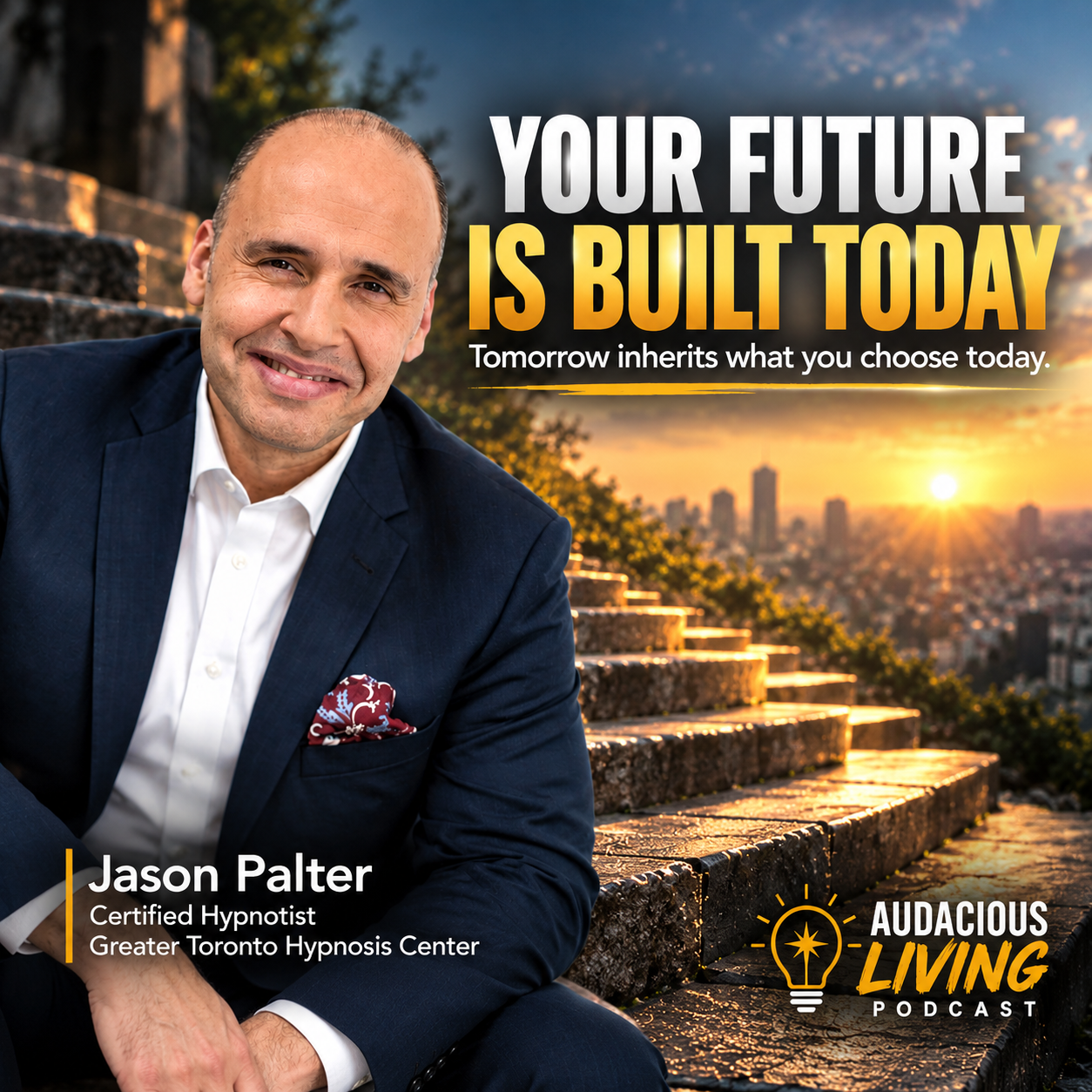
Jason Palter, a certified hypnotist and owner of Greater Toronto Hypnosis Center, spends much of his work around patterns. In our conversation, he described how habits can become a kind of muscle memory. A response gets repeated enough times that eventually it feels automatic. Stress appears and the familiar coping mechanism follows. A setback happens and the familiar story returns. We stop deciding consciously because the pattern has learned how to decide for us.
That matters because patterns compound. A choice does not have to be catastrophic to take you somewhere you never intended to go. It only has to become familiar enough that you stop questioning it.
The reverse is also true. A better choice, repeated, can become familiar too.
Your Patterns Are Practising a Future
One of the most useful ideas in the conversation was Jason's comparison between habits and muscle memory. You may not have ridden a bicycle or swum in years, yet your body retains something from the repetition. Behaviour can work similarly. What we rehearse becomes easier to return to.
That means every repeated pattern is practising something.
If your default response to difficulty is “I can’t,” you are practising retreat. If your default response to uncertainty is to wait until you feel completely ready, you are practising postponement. If your internal language continually reduces you, you are practising an identity that your future self will eventually have to challenge.
Jason put it simply: “thoughts become words become actions.” He also urged people to be careful about what follows the words “I am.” That is not an argument for pretending everything is wonderful. It is an invitation to notice when your language has stopped describing a moment and started defining who you believe you are.
There is a meaningful difference between “I failed at this” and “I am a failure.” One describes an event. The other tries to turn the event into an identity.
Comfort Is Often Disguised as Certainty
We like certainty because certainty feels safe. The problem is that waiting for certainty can become its own decision.
Jason spoke about clients who know a habit, job or relationship is no longer serving them but have not yet reached the point where they are ready to change it. Knowing and experiencing, he observed, are different things. At some point, insight has to become action.
That action does not always mean charging forward alone. Sometimes the audacious decision is admitting that you need help. A counsellor, therapist, coach, trusted friend or another appropriate professional can become part of the next step. Asking for help does not erase agency. It can be an expression of it.
The future is not built by proving you can do everything yourself. It is built by making decisions that give you a better chance of becoming who you want to become.
Shape What You Can, Release What You Cannot
There is another trap hidden inside our desire to build a better future: the belief that progress requires control over everything that happens next.
Jason challenged that idea directly:
“I think oddly we all know deep down, I mean, if we really think about it, and you don't have to think about it that hard, control's an illusion. We really have no control. There's things that just happen. ⁓ I think the only thing we can quote control is our attitude, is our reactivity to something. ⁓ we can try to shape our future and you know, go for this job or or take this course to help build up our resume or ⁓ you know to to to stop our s our smoking or a bad habit or lose the weight, or whatever to try.”
— Jason Palter
Certified Hypnotist and Owner, Greater Toronto Hypnosis Center
That distinction matters. Shaping your future is not the same as controlling it. You can take the course and still not get the job. You can make a healthier choice and still face circumstances you never invited. You can prepare carefully and still be surprised.
The work is to stop confusing uncertainty with powerlessness. You may not control the outcome, but you can influence the direction. Today’s decision is one of the tools you actually have.
That makes intentional action more valuable, not less. You do what you can with what is available now, then meet what comes next without demanding that life follow your script.
The Decision Is Smaller Than the Destination
“Future self” can sound abstract because the destination feels far away. A better approach is to shrink the question.
What decision is available today?
Not the entire reinvention. Not the perfect five-year plan. Not a guarantee that everything will work. Just the next decision that makes tomorrow slightly stronger than yesterday.
Maybe it is replacing “don’t forget your keys” with “remember your keys,” one of Jason’s simple examples of changing the direction of our language. Maybe it is noticing the engine light instead of waiting for the breakdown. Maybe it is allowing yourself to rest instead of confusing exhaustion with commitment. Maybe it is releasing some control so you can actually move.
Small does not mean insignificant. Repeated small decisions are how a pattern is built.
Lessons for Living Life Audaciously
Living audaciously is easy to associate with the visible leap: starting the company, changing careers, leaving what no longer fits, saying yes to the opportunity. Sometimes audacity looks exactly like that.
Other times, it is almost invisible.
It is choosing the action your future self will benefit from even when immediate comfort is offering a more attractive deal. It is catching the old sentence before you repeat it. It is asking for help. It is trying again without pretending the fall did not hurt. It is accepting that control is limited while taking responsibility for the attitude and actions that are still yours.
The useful question is not whether you can control exactly who you will become. You cannot control every circumstance that will meet you along the way. A better question is whether today’s choices are giving that future version of you something useful to inherit.
One decision will not build an entire life. It can, however, cast a vote for the direction you are heading. Make enough of those votes intentionally and, over time, what once required courage can begin to feel like muscle memory.
