
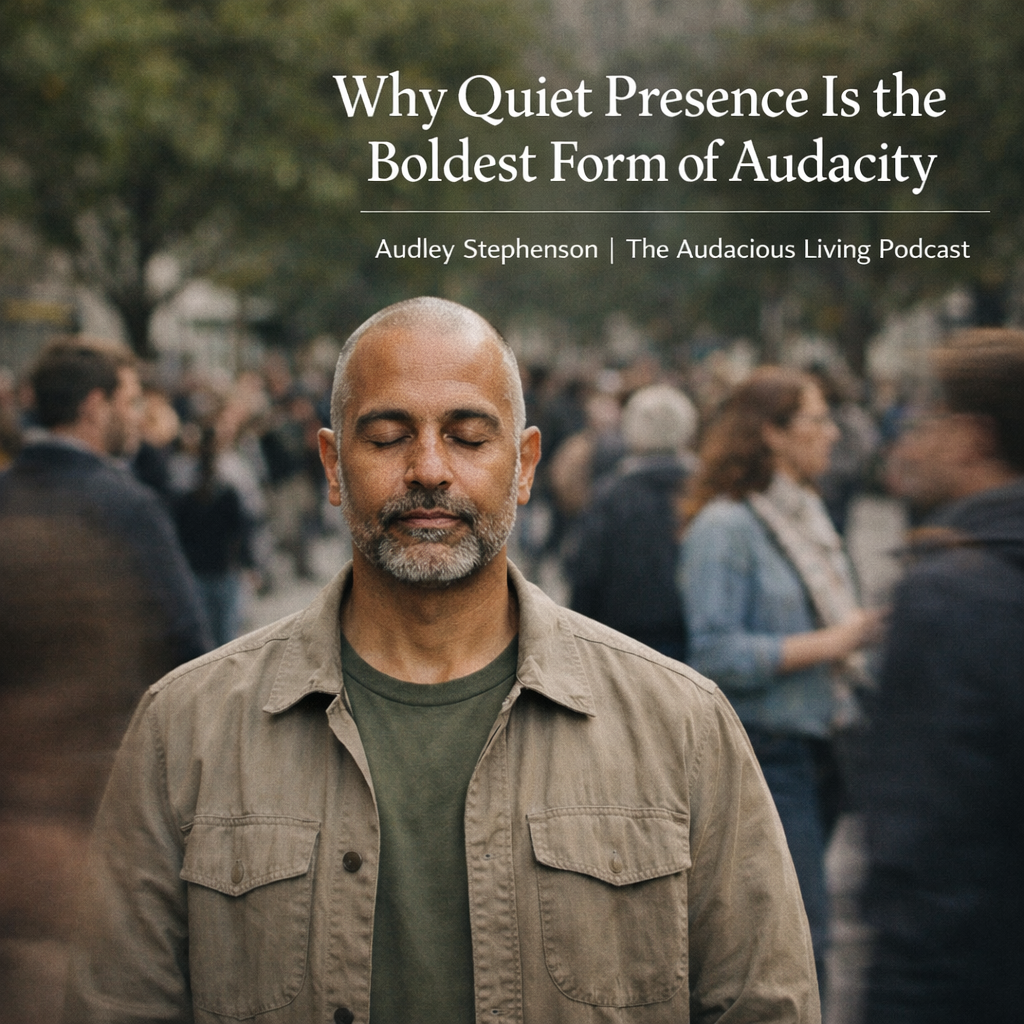
Explore how mindfulness and presence can create powerful ripple effects in your relationships, leadership, and daily decisions.
There is a version of audacity that does not shout.
It does not always look like a dramatic leap, a public risk, or a bold declaration. Sometimes, the boldest thing you can do is stay present. To pause before reacting. To notice the stories in your head without letting them control you. To meet yourself, and others, with more compassion.
That is exactly what emerged in this thoughtful conversation on The Audacious Living Podcast, as Audley Stephenson sat down with Lodro Rinzler to explore mindfulness, self-doubt, meditation, and the idea of basic goodness. What unfolded was a powerful reminder that quiet presence is not passive at all. In many ways, it is one of the most courageous ways to live.
Why This Topic Matters
So many of us are walking through life carrying invisible stories.
Stories that say we are behind. Stories that say we are not enough. Stories that tell us we have to prove ourselves, perform for approval, or keep moving so we do not have to sit with what is really going on inside us.
And yet, those stories often are not rooted in truth. They are reactions. Assumptions. Old emotional patterns. Fear dressed up as fact.
That is why this conversation matters.
Lodro speaks directly to what so many people wrestle with every day: the inner voice that questions our worth, our ability, and our place in the world. He describes it as a “trap of doubt,” and that language lands because it captures how stuck we can feel when self-doubt tightens its grip.
The deeper invitation here is to recognize that presence is not about escaping life. It is about returning to it. Fully. Honestly. Intentionally.
Insights from the Conversation
One of the strongest ideas from this conversation is that many of the thoughts that hold us back are simply stories we keep repeating. They may feel true, but that does not make them true. When we believe those stories without questioning them, they shape our decisions, our confidence, and even the way we interpret other people’s actions.
Lodro offers a practical interruption to that spiral: ask, Is this helpful? That question creates space. It shifts us out of automatic reaction and back into awareness. It reminds us that not every thought deserves authority.
Another powerful insight is the Buddhist idea of basic goodness. Rather than seeing ourselves as fundamentally flawed and in need of fixing, Lodro challenges us to consider a different starting point: what if we are already good as we are? What if the real work is not becoming worthy, but remembering that we already are?
That shift changes everything. It changes how we respond to mistakes. It changes how we handle insecurity. It changes how we lead, parent, love, and recover from setbacks.
The conversation also makes a compelling link between presence and impact. When we are less trapped in our own heads, we are more available to the world around us. We notice what matters. We listen better. We respond with greater care. We become more capable of making meaningful ripples in someone else’s life, often without even realizing it.
That is where quiet presence becomes audacious.
Not because it is flashy, but because it is rare.
“Those are just stories.”
That line lands because it reframes storytelling entirely. We often think of technology as machines, code, systems, and devices. But storytelling came first. Long before modern tools, story was how people preserved wisdom, passed down values, tracked identity, and made sense of the world. In that way, storytelling is not separate from innovation. It is the foundation of it.
Lessons for Living Audaciously
Living audaciously is not always about making bigger moves. Sometimes it is about making truer ones.
This conversation reminds us that audacity can look like resisting the urge to believe every fearful thought. It can look like starting the day with gratitude instead of anxiety. It can look like taking ten quiet minutes to reconnect with yourself before the noise of the world rushes in.
It can also look like choosing compassion over assumption.
That matters in leadership. It matters in relationships. It matters in the everyday moments where we decide whether we will show up from reactivity or from intention.
If you want to create a stronger legacy, presence is part of the path. People may forget your exact words, but they will remember how you made them feel. They will remember whether you saw them. Whether you were really there.
And that kind of presence has ripple effects far beyond what you can measure.
Closing Reflection
The world often teaches us to chase visibility, speed, and constant output.
But maybe the boldest thing is not to do more. Maybe it is to be more fully here.
To quiet the noise.
To question the story.
To trust your basic goodness.
To meet this moment with care.
Because when you do that, you do more than calm your mind. You change the way you move through the world.
And sometimes, that quiet shift is the most audacious act of all.
Listen to the Full Conversation
This insight comes from a powerful episode of The Audacious Living Podcast with Audley Stephenson, where conversations explore leadership, resilience, and what it means to live audaciously.
🎧 Listen to the full episode here.
