
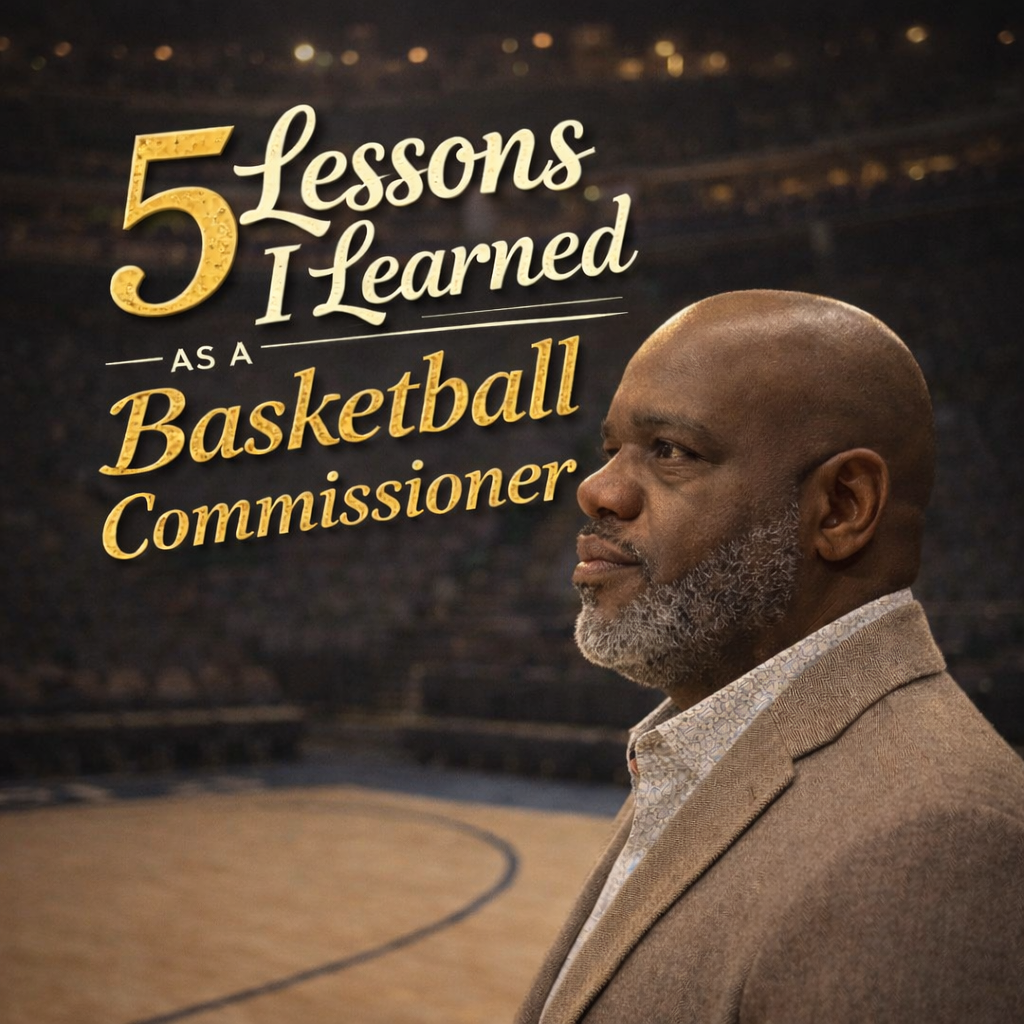
With the KW Titans and Sudbury Five facing off in the 2026 Basketball Super League Finals, I’ve found myself thinking about the moments behind the scenes that fans never see.
The pressure. The decisions. The trade-offs.
And everything it takes to get to this point so congratulations to both teams - your efforts aren't lost on me.
It actually takes me back to my time as Commissioner of the National Basketball League of Canada—and the lessons that experience taught me about leadership, pressure, and audacity.
Here are five that have stayed with me.
1. Leadership Is Choosing Trade-Offs, Not Finding Perfect Solutions
One of the biggest complaints we used to hear as a league was about scheduling—especially during the playoffs.
Fans would look at the calendar and ask:
“Why is this game on a Tuesday?”
“Why would you schedule this on a holiday?”
And honestly, I get it.
Weekends are ideal. That’s when families can come out, enjoy the experience, and be fully present.
But what most people didn’t see was what was happening behind the scenes.
Many of our teams played in hockey arenas and in Canada, hockey gets priority. Those teams got first choice on dates—weekends, prime time slots, the best availability.
We got what was left.
So now you’re trying to build playoff momentum, create a great fan experience, and your options are:
A Tuesday night
A Monday evening
Or a holiday that doesn’t work for everyone
And you still have to make it work.
But there was another layer to it.
We weren’t just trying to find better dates—
we were trying to protect the flow of the series.
If Game 1 starts on a Monday, you can’t wait until the weekend for Game 2.
You lose momentum.
At the same time, if one round ends, you don’t want to wait five or six days—sometimes longer—to start the next one.
You want to keep things moving.
You want to keep people engaged.
So now you’re balancing availability…
with momentum…
with fan experience…
knowing that no matter what you choose, someone’s going to be frustrated.
Every decision solved one problem—and created another.
That’s when I learned:
Leadership isn’t about finding the perfect solution.
It’s about choosing which trade-off you’re willing to accept.
2. You’re Accountable for Everything — Even What You Don’t Control
Another reality of leading a league is that you’re not just responsible for the games—you’re responsible for everything connected to it and that includes the people.
Many of our players were young men chasing a dream. Some had strong support systems. Others were still figuring things out—on and off the court.
And like any group of young people, mistakes happened.
Sometimes those mistakes became public and when they did, the criticism didn’t go to the individual.
It came to the league.
It came to me.
“What kind of league are you running?”
“This is a bush league.”
It's in those moments, you feel it immediately because the spotlight doesn’t stay on the player… it shifts to the league.
Now, the easy response would’ve been: “We can’t control what every player does.”
But leadership doesn’t work that way.
Because when you’re in that seat, people aren’t looking for explanations—they’re looking for accountability.
So even when situations were outside of our direct control, we still had to respond.
We had to address the behavior.
We had to reinforce standards.
We had to protect the integrity of the league.
What that taught me is this:
Leadership isn’t about controlling everything.
It’s about owning everything.
3. Every Perspective Matters — But Not Every Perspective Decides
Being commissioner felt like living in a fishbowl.
Our stakeholders weren’t just one group.
They were fans.
Players.
Teams.
The media.
Potential partners.
Existing investors.
And they all had a perspective.
They all had something they felt needed to be heard.
And many believed their view should carry the final say.
“You should be more like the NBA.”
“The league needs to do this.”
“Why aren’t you doing that?”
Here’s the truth—none of those perspectives were wrong.
They were just coming from different viewpoints.
Fans were thinking about entertainment.
Players were thinking about opportunity.
Teams were thinking about sustainability.
The media was focused on narrative and scrutiny.
Partners and investors were thinking long-term viability.
And I was hearing all of it.
Constantly.
The challenge wasn’t listening.
The challenge was filtering.
And the hardest part?
Many of those perspectives made sense—just not at the same time because while every perspective has value, not every perspective fits the reality you’re operating in.
We weren’t the NBA. We didn’t have their resources, their infrastructure, or their margin for error.
So while the comparisons were understandable, the expectations weren’t always realistic.
And that’s where leadership gets tested.
Leadership isn’t about agreeing with every perspective.
It’s about understanding them… and still making the call.
4. Stand on Your Standards — Especially When It’s Unpopular
One of the toughest parts of leading the league showed up around player discipline.
There were moments when a player would do something on the court that clearly crossed the line—something that required action and we had rules for that.
We had standards.
We had a framework.
But here’s what I learned quickly:
No matter what decision was made… it was never enough for someone.
Some felt the punishment was too light.
Others felt it was too harsh.
Some compared it to previous situations.
Others questioned why it wasn’t handled differently years ago.
Everyone had an opinion and everyone felt justified in it.
It was in those moments when leadership can feel like a lonely place.
Because you’re not in that role to make friends.
And you’re not going to make everyone happy.
That’s just the reality of it.
Especially in a growing league, where you’re still building history.
You don’t always have years of precedent to point to.
You’re creating the standard in real time.
So as a leader, you have a choice.
You can chase approval…
Or you can stand on your standards.
We chose consistency.
Not because it was popular—but because it was necessary.
Because once you start adjusting standards to satisfy pressure,
you’re no longer leading—you’re reacting and in leadership, credibility is everything.
Leadership isn’t about making decisions people agree with.
It’s about making decisions you can stand on—even when no one else does.
5. You Don’t Become Ready — You Become Ready by Leading
When I stepped into the role of commissioner, I didn’t have everything figured out.
There was no perfect blueprint. No step-by-step guide.
What I had was a willingness to step into the responsibility.
At the time, I was supposed to be working alongside David Magley—learning the role, growing into it, understanding it from the inside.
David wasn’t just the commissioner.
He was someone I respected.
Someone I considered a friend.
But when he stepped down, the role didn’t wait.
It was there.
And I had to step into it because leadership doesn’t wait.
The games still get played.
The decisions still need to be made.
The expectations don’t pause while you figure things out.
There were moments I had to make calls without full clarity.
Moments I had to show confidence while still processing things behind the scenes.
Moments where the weight of the role was very real.
There were moments I had to make decisions…
and then sit with them afterward, hoping I got it right.
But the job didn’t slow down and neither could I.
What that experience taught me is this:
You don’t become ready and then lead.
You lead—and become ready along the way.
That’s where audacity lives.
Not in having all the answers…
But in stepping forward anyway.
Final Thought
Despite the hard lessons I’ve shared throughout this article, my time as Commissioner of the National Basketball League of Canada was, without question, the most rewarding professional experience of my life.
It challenged me. It stretched me. It forced me to grow in ways I never could have anticipated. I learned how to lean on myself, trust my instincts, and move forward with conviction, even in the face of uncertainty.
And while there were difficult moments, there were also countless moments of joy, pride, and purpose.
I had the privilege of connecting with fans who were genuinely grateful for what we were building. People who saw the league as more than just basketball, but as something that brought communities together.
I had players approach me regularly, thanking me for the opportunity to chase their dreams. To play the game they love at a professional level. To be seen. To be valued.
Those moments stayed with me.
Because the truth is, I wasn’t doing it for recognition. I wasn’t doing it to elevate my own platform or status. I was doing it to create something meaningful for others. To contribute to the game that gave me so much. To build something that mattered.
And that’s what made it all worth it.
No matter how difficult the lessons were… the rewards were even greater.
That’s the power of audacity — stepping into the unknown, trusting the process, and discovering that who you become on the other side is worth everything you went through.
