
Removing the Labels That Keep Us Apart
Introduction
It's remarkably easy to decide who someone is before we've ever taken the time to know them.
The neighbour with the unkempt yard becomes "the difficult one." The quiet co-worker is labelled unfriendly. The parent who never joins community events is assumed to be disinterested. Without realizing it, we create stories about people using only the few details we can see.
The problem is that labels often tell us more about our assumptions than they do about another person's reality.
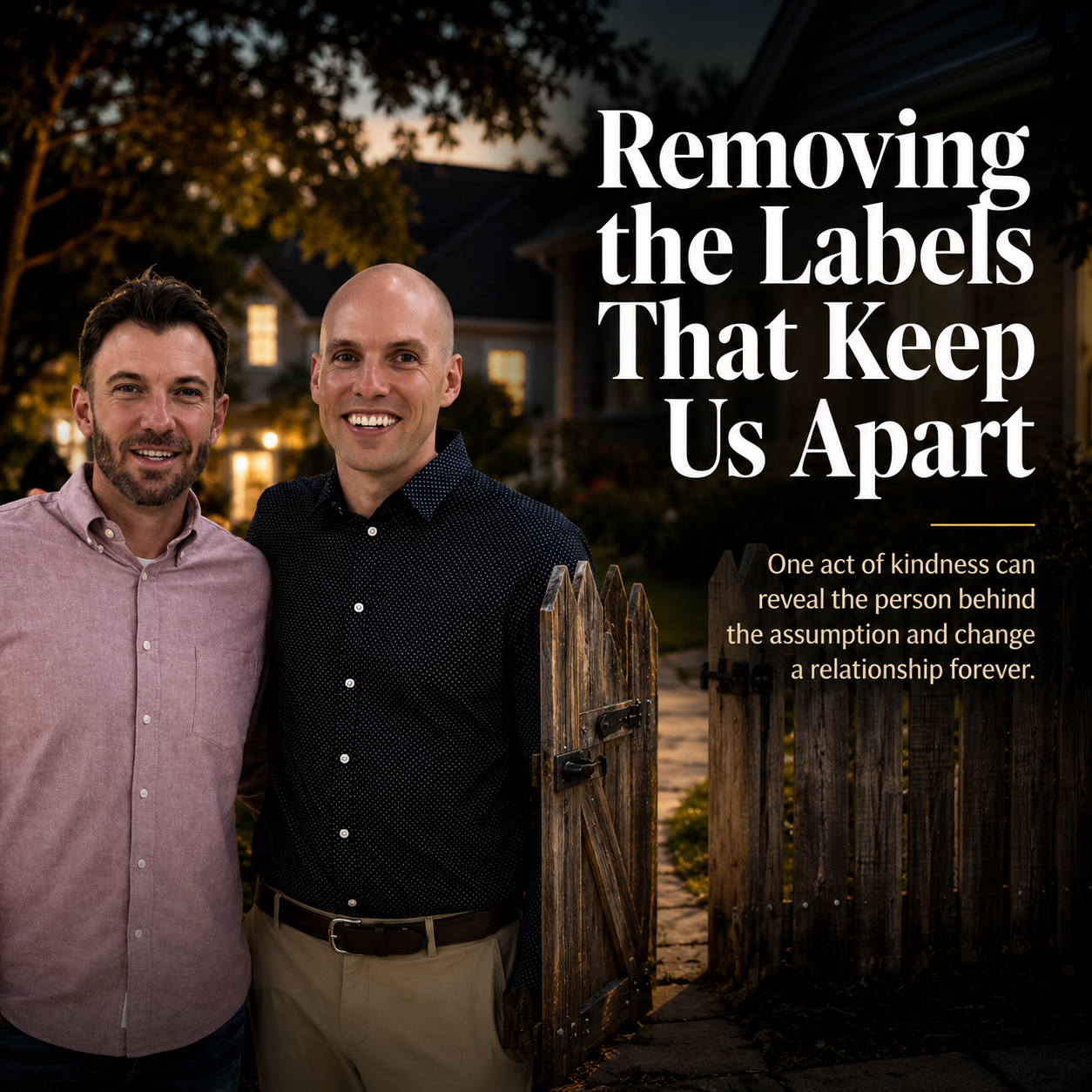
During my conversation with Ty Dannenbring and Jeff Dillon, co-authors of Party in the Front!, we explored how genuine community begins when we're willing to move beyond first impressions. Their message wasn't simply about organizing neighbourhood gatherings. It was about replacing assumptions with curiosity and discovering that behind nearly every label is a story waiting to be understood. Their conversation centred on community, hospitality, meaningful relationships and the intentional choice to move toward people instead of away from them.
Why This Conversation Matters
Labels help our brains simplify the world.
They're quick. Convenient. Efficient.
Unfortunately, they're also incomplete.
When we reduce someone to a single characteristic, we stop looking for the rest of their story. The neighbour becomes "the grumpy one." The new family becomes "the private ones." The person who rarely smiles becomes "unapproachable."
Once we've accepted the label, every future interaction tends to reinforce it.
Ty and Jeff suggest something radically different.
Rather than asking whether someone deserves our kindness, they encourage us to ask what experiences might have shaped the person standing in front of us. That small shift changes everything because curiosity leaves room for compassion, while assumptions usually reinforce distance.
Community doesn't disappear because people stop caring.
Often, it weakens because people stop wondering.
The Story Behind the Label
One of the most powerful moments in our conversation came through a story Jeff shared about friends who had recently moved into a new neighbourhood.
Living next door was a woman almost everyone had written off.
Her yard was neglected.
Police had been called to her home more than once.
She yelled at neighbourhood children.
Most people kept their distance and quietly hoped she would move away.
Instead of accepting the neighbourhood's opinion, Jeff's friends decided to do something remarkably ordinary.
One winter morning they shoveled her sidewalk.
Later, they left a homemade loaf of bread on her doorstep.
Neither gesture was dramatic.
Neither came with expectations.
But those simple acts of kindness opened the door to conversation. Eventually, the woman shared the heartbreaking story of losing her husband years earlier in a tragic accident while he was trying to save one of their children.
Suddenly, the label disappeared.
The difficult neighbour became a grieving widow.
The neglected property no longer defined her.
Her pain did.
The remarkable part of the story isn't that her circumstances immediately changed.
Jeff admits her lawn was still messy.
What changed was how everyone saw her.
Grace replaced judgment because understanding had replaced assumption.
That may be one of the most important lessons any community can learn.
Seeing People Instead of Assumptions
It's tempting to believe that labels protect us.
If we can quickly decide who people are, we feel like we've made sense of the world around us. But labels often become barriers that prevent the very relationships we're longing for.
Ty and Jeff repeatedly returned to one idea throughout our conversation: meaningful connection requires intentionality. Relationships rarely deepen by accident. Someone has to be willing to take the first step.
That first step doesn't need to be elaborate.
It might be introducing yourself after years of simply waving from the driveway. It might be lingering a little longer while checking the mail. It might be sitting on the front porch instead of disappearing into the backyard.
These actions may seem insignificant, but they communicate something powerful:
"I'm open to knowing you."
That openness creates space for stories to emerge. And stories have a remarkable way of dismantling labels.
Ty explained that meaningful conversations go beyond casual greetings. They allow us to understand another person's joys, struggles and burdens. Only then can we truly celebrate with someone or support them through difficult seasons.
It's difficult to care deeply about someone whose story you don't know.
Kindness Creates Safe Places
One of the strongest themes woven throughout the conversation wasn't strategy. It was hospitality.
Not hospitality as entertaining.
Hospitality as making people feel seen.
Jeff described the front yard as more than a physical location. It represents a place of openness where people can encounter one another without pressure. Unlike inviting someone into your home immediately, the front yard offers a neutral space that feels welcoming and approachable. More importantly, it's also a metaphor for allowing others to see our authentic selves instead of carefully managing appearances.
That kind of authenticity invites trust.
Ty suggested that successful connection isn't built on perfection but on simple ingredients like humility, food, music and laughter. Those elements create environments where people naturally relax, lower their guard and begin to connect.
Kindness isn't merely something we do.
It's something people experience.
Sometimes the smallest gesture becomes permission for someone else to believe they're welcome.
Lessons for Living Audaciously
Living audaciously isn't always about taking centre stage.
Sometimes it's choosing compassion over assumption.
Every one of us carries labels we've accepted about ourselves, and every one of us has likely placed labels on someone else. The courage lies in questioning both.
What if the person you've quietly written off is carrying a story you simply haven't heard yet?
What if your next conversation replaces judgment with understanding?
What if one small act of kindness changes not only another person's day but also the way you see the world?
Ty and Jeff remind us that community isn't built through grand events. It's built one relationship at a time, one conversation at a time and one act of intentional kindness at a time. Those seemingly ordinary moments have an extraordinary way of revealing the humanity we've overlooked.
Living audaciously means resisting the temptation to define people by first impressions. It means choosing curiosity over certainty, empathy over convenience and connection over isolation.
Because when we remove the labels that keep us apart, we create space for something far more meaningful:
We finally begin to see one another.
Conclusion
Every meaningful relationship begins with a single decision: to move toward someone instead of away from them.
If this conversation resonated with you, I encourage you to listen to the full episode with Ty Dannenbring and Jeff Dillon on The Audacious Living Podcast. Their insights offer practical, hope-filled reminders that stronger communities don't begin with bigger events—they begin with people willing to see beyond the labels.
And if you enjoyed this article, subscribe to the podcast, share it with someone in your community and continue the conversation. Sometimes the smallest step toward another person becomes the beginning of something extraordinary.
