
Resilience Built in the Valley: Why Growth Happens When Life Gets Hard
Introduction
There are seasons in life when everything seems to make sense. Relationships are healthy. Work feels meaningful. Confidence comes naturally. Those are the moments we often celebrate.
But life doesn't stay on the mountaintop forever.
Eventually, disappointment arrives. Loss finds us. Plans unravel. We encounter circumstances we never would have chosen, and suddenly we find ourselves standing in a valley we didn't expect to enter.
Our instinct is usually to get out as quickly as possible.
Yet what if the valley isn't simply something to survive?
What if it's where some of life's most important growth actually begins?
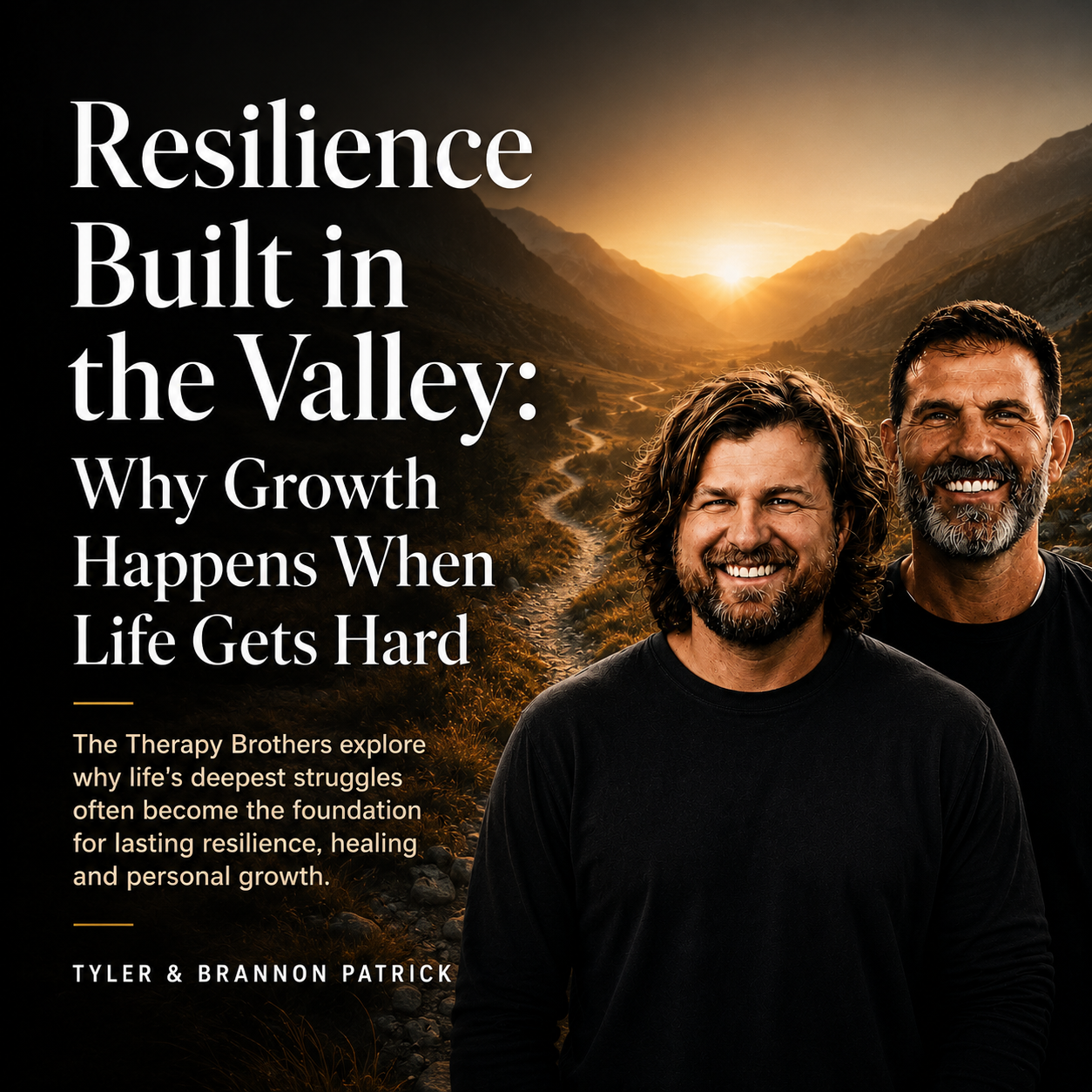
That question sat at the heart of my conversation with Tyler and Brannon Patrick, better known as The Therapy Brothers. Their work has placed them alongside people navigating betrayal, addiction, trauma and broken relationships. Again and again, they've witnessed something remarkable: while no one chooses hardship, many people discover their greatest strength because of what they learn while moving through it—not around it.
Why This Conversation Matters
Our culture loves quick solutions.
When something hurts, we're encouraged to fix it, suppress it or distract ourselves from it. Success is often measured by how quickly we can return to "normal."
But healing rarely follows that timeline.
Tyler explains that many people enter therapy believing the visible problem is the entire problem. They want to eliminate the addiction, repair the relationship or stop the unwanted behaviour. Yet those struggles are often symptoms rather than the source. Real healing begins by exploring the deeper beliefs, experiences and wounds that shaped those behaviours in the first place.
That's true well beyond the therapy office.
Whether we're navigating disappointment at work, the loss of a relationship, unexpected change or a personal failure, the challenge isn't simply overcoming what happened. It's understanding how those experiences shape the way we see ourselves—and deciding whether we'll allow them to define our future.
Growth begins when we become curious about the lesson instead of simply trying to escape the discomfort.
The Valley Isn't the End of the Story
Early in our conversation, I shared a perspective that has helped me make sense of life's ups and downs.
Life moves through hills and valleys.
The hills represent joy, achievement and celebration. The valleys represent disappointment, struggle and uncertainty. Neither lasts forever. The challenge isn't avoiding the valleys—it's learning how to move through them without believing they'll last forever.
Tyler and Brannon expanded on that idea beautifully.
They suggested that many of life's greatest treasures are discovered while working through the difficult places. The experiences we'd gladly avoid often become the very experiences that reshape our identity, deepen our compassion and strengthen our resilience.
That doesn't make suffering desirable.
It makes it meaningful.
There's an important difference.
Meaning doesn't erase pain. It gives pain a purpose.
Lasting Change Happens From the Inside Out
One of the most powerful ideas from our conversation was the distinction between managing behaviour and transforming identity.
It's tempting to believe that changing a habit automatically changes a life.
Sometimes it does.
Often it doesn't.
The Therapy Brothers described lasting healing as an "emotionally corrective experience"—a moment where change reaches beyond intellectual understanding into the heart, emotions and lived experience. Simply talking about change isn't enough. Lasting transformation occurs when people begin living differently because they genuinely see themselves differently.
That's a lesson we can all apply.
Reading another book, listening to another podcast or attending another seminar can certainly help. But information alone rarely transforms us.
Growth happens when knowledge becomes practice.
When awareness becomes action.
When intention becomes habit.
Resilience Is Built Through the Process, Not the Shortcut
During our conversation, we also explored the difference between wanting a quick fix and being willing to do the work.
Those are not the same thing.
Tyler described personal growth as a process rather than an event. People who experience lasting change eventually stop chasing immediate results and begin embracing consistent effort. They understand that meaningful progress comes through humility, openness and a willingness to stay engaged even when the work becomes uncomfortable.
That perspective aligns closely with something I often share through my BOLD Framework.
Adversity is unavoidable.
The question isn't whether we'll encounter challenges.
The question is who we'll become because of them.
Resilience isn't something we suddenly discover during difficult moments. It's something we quietly build every time we choose growth over resignation, learning over avoidance and courage over comfort.
Every difficult season becomes another opportunity to strengthen that foundation.
Your Response Shapes the Meaning of Your Experience
Perhaps the most hopeful part of our conversation centred on trauma.
The word itself often feels overwhelming.
Many people associate trauma only with catastrophic events, yet Tyler reminded us that life's experiences continually shape the lens through which we see ourselves and the world around us. Left unexamined, those experiences often become unconscious reactions driven by fear rather than intentional choices.
But they don't have to remain that way.
Brannon offered a perspective that stayed with me.
He suggested that while we can't always choose what happens to us, we can choose what we allow those experiences to produce within us. Rather than remaining trapped by painful experiences, we can eventually ask a different question: What can this experience produce through me?
That isn't easy.
In fact, it's one of the hardest shifts any of us will ever make.
But it's often the beginning of genuine resilience.
Lessons for Living Audaciously
Living audaciously doesn't mean avoiding hardship.
It means refusing to let hardship write the final chapter of your story.
Every one of us will spend time in the valley.
We'll experience disappointment, uncertainty, grief and moments that challenge how we see ourselves.
The invitation isn't to pretend those moments don't hurt.
It's to believe they still have something to teach us.
Resilience grows every time we choose honesty over denial.
Every time we embrace the process instead of demanding instant results.
Every time we respond with courage rather than allowing fear to make our decisions.
The valley may not be where you wanted to be.
But it may become the place where you discover strengths, wisdom and purpose you could never have found anywhere else.
Sometimes the greatest breakthrough isn't found after life becomes easier.
Sometimes it's discovered because you kept walking through the valley.
Conclusion
If this conversation resonated with you, I encourage you to listen to the full episode with Tyler and Brannon Patrick of The Therapy Brothers. Their insights offer a thoughtful reminder that healing isn't about avoiding life's hardest moments—it's about learning how those moments can shape who we become.
And if you found value in this article, consider subscribing to The Audacious Living Podcast, sharing this episode with someone who may need it, and continuing the conversation about what it means to live your best audacious life.
