
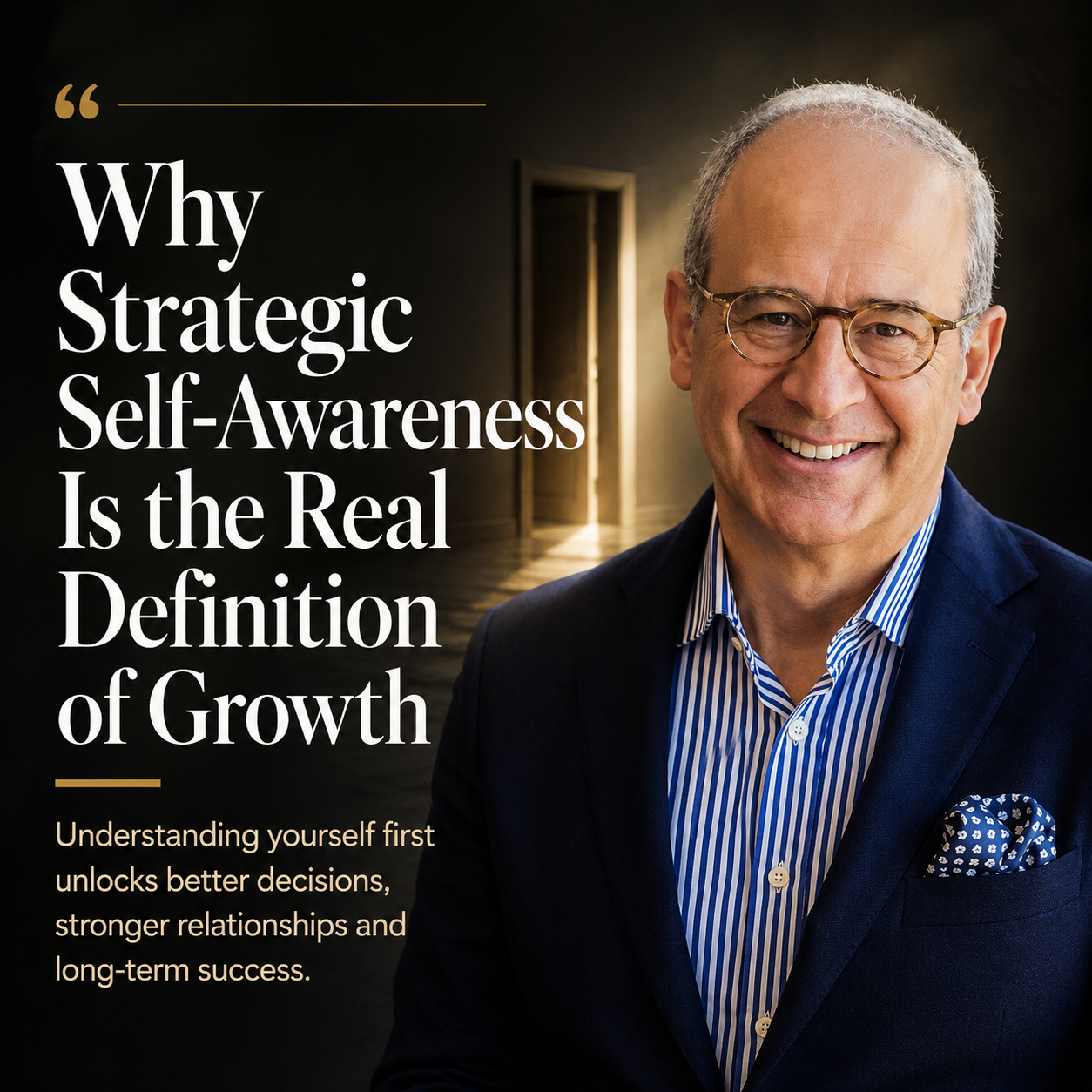
Why Strategic Self-Awareness Is the Real Definition of Growth”
Growth is often described by what other people can see.
Introduction
A new position. A larger network. A stronger résumé. A new qualification. More influence, responsibility or income. These achievements can certainly reflect progress, but they do not always tell us whether a person has genuinely grown.
Real growth is often much quieter.
It happens when you recognize a pattern that has been affecting your decisions. It happens when you become aware of how you respond under pressure, what causes you to become defensive or why certain situations repeatedly drain your energy. It happens when you stop reacting automatically and begin choosing your response with greater intention.
That is strategic self-awareness: understanding yourself well enough to make better choices about how you think, respond, relate and move forward.
During my conversation with Ahmet Bozer, former president of Coca-Cola International and author of Soulgery, he explained that his leadership philosophy begins with a simple principle: before you can lead others well, you must learn to lead yourself well. His experience taught him that external results and internal development are not separate. Lasting effectiveness begins by cultivating a stronger inner self and carrying that awareness into every role you play.
Why This Conversation Matters
We live in a culture that makes external progress easy to measure.
You can count promotions, followers, awards, clients and certifications. You can point to a finished project or a goal you reached. Internal growth is harder to display because it does not always come with an announcement.
You may have become more patient, but there is no certificate for that. You may now recognize when fear is influencing a decision, but no one hands you an award. You may have learned to listen without becoming defensive, recover from disappointment more quickly or treat yourself with greater grace. These changes are less visible, but they shape almost everything else.
Ahmet noted that people frequently define growth through external acquisitions—new skills, achievements or relationships—while overlooking its internal dimension. Yet the internal work often creates the foundation that makes sustainable external achievement possible.
Without self-awareness, we may accomplish more while continuing to repeat the same emotional and relational patterns. We may become more successful without becoming more fulfilled. We may gain authority without becoming better leaders. We may work harder without understanding whether the direction we are travelling still reflects who we are.
Strategic self-awareness matters because it gives us a reliable starting point. You cannot intentionally change what you have not yet recognized.
Growth Begins by Turning on the Light
During our conversation, I compared self-awareness to entering a dark living room.
The sofa, television, tables and lamps are all present whether the light is on or off. Turning on the light does not create anything new. It simply allows you to see what was already there.
Once you can see the room, you can move through it without repeatedly hurting yourself. You can decide whether the furniture needs to be rearranged. You might even discover something that has been quietly collecting dust.
That is what self-awareness does.
It reveals the internal landscape you have already been navigating: your assumptions, emotional triggers, strengths, insecurities, habits and default reactions. It allows you to examine what is serving you and what may need to change.
This does not mean every discovery will be comfortable. Ahmet acknowledged that self-awareness is difficult partly because we are living inside the very experience we are attempting to examine. It is much easier to observe what someone else is doing wrong than to study ourselves with the same clarity.
Looking inward may also uncover something we would rather avoid. That discomfort can cause us to remain constantly busy, chasing the next goal so that we never have to sit quietly with ourselves. Ahmet described self-reflection as an intimate encounter with yourself—one that becomes stronger with practice, much like a muscle.
The purpose of turning on the light is not to criticize everything in the room. It is to see clearly enough to choose what happens next.
Self-Awareness Improves the Way We Make Decisions
Our decisions do not begin when we select an option. They begin with how we interpret the situation in front of us.
That distinction becomes especially important during adversity.
When we feel challenged, disappointed or threatened, our default patterns can take control. We may assume the worst about another person’s intentions. We may become overly protective, impulsive or pessimistic. We may respond to what we fear is happening rather than what is actually happening.
Ahmet encouraged people to begin by asking whether they understand the situation as completely and accurately as possible. That includes examining the judgements they are making and considering whether there is room for what he calls a “smart bias for positivity”—not blind optimism, but a willingness to avoid automatically assigning negative intent.
From there, a thoughtful response requires three things: a vision for how you want to emerge from the situation, a deliberate process for making the necessary decisions and psychological preparation to act on those decisions.
This is where strategic self-awareness becomes practical.
You begin to recognize your default mode. You notice whether you tend to withdraw, become defensive, rush to solve the problem or imagine the worst possible outcome. Awareness creates a pause between the trigger and the response.
That pause gives you room to ask:
What am I assuming?
What emotion is driving me?
What outcome do I actually want?
What information am I missing?
How do I want to show up in this moment?
You may not always make the perfect decision, but you are far more likely to make an intentional one.
Better Relationships Begin with Understanding Yourself
Self-awareness is sometimes treated as a private exercise, but its effects are deeply relational.
When you understand your own patterns, you become less likely to place the responsibility for all your feelings on someone else. You can distinguish between what another person has actually done and what their actions may have activated within you. You become better equipped to communicate clearly rather than expecting people to interpret reactions you have not yet understood yourself.
That same awareness can strengthen leadership.
Ahmet’s experience across international markets reinforced his belief in what he calls the “common currency of humanity.” Across differences in culture, geography and professional roles, people want to be recognized, respected and treated with authentic care. He found that connecting human to human—not merely through titles or organizational hierarchy—created stronger relationships and allowed people to bring more of their potential forward.
A self-aware leader understands that their mood, reactions and assumptions affect the environment around them. They recognize that creating a high-performing team is not only about directing work. It is also about building conditions in which people feel seen and are able to contribute at their best.
This principle extends beyond the workplace. We bring the same inner self into our relationships as parents, partners, colleagues and community members. Ahmet described the individual as one integrated person playing different roles, all of which emerge from the same internal foundation.
When that foundation becomes stronger, the quality of our relationships can become stronger too.
Strategic Reflection Turns Patterns into Progress
Awareness alone is not growth.
You can recognize a pattern and still continue repeating it. Strategic self-awareness requires observation followed by intentional practice.
Ahmet shared an example involving his tendency to imagine overly pessimistic scenarios. Rather than simply accepting that tendency as part of his personality, he began recording moments when it appeared. He periodically reviewed his notes and evaluated whether the pattern was becoming less dominant.
For him, that gradual change represented genuine growth. By repeatedly observing and working on the behaviour, he was building a new internal muscle.
This is a more useful way to think about self-improvement than attempting to transform your entire life at once.
Identify one recurring pattern.
Notice when it appears.
Examine what activates it.
Consider how it influences your choices.
Practise a more constructive response.
Then review what happened without condemning yourself.
The reflection matters because it converts an experience into information. Without reflection, we can endure the same lesson repeatedly without learning from it.
Ahmet also described moments when his mind felt overwhelmed by several concerns at once. Writing each issue down allowed him to separate what he could control from what he could not, determine what action was realistically available and understand more clearly why he was feeling discouraged.
That process does not eliminate every difficulty. It clears enough of the mental landscape to help you move forward deliberately.
Inner Growth Creates More Meaningful Success
Self-awareness also helps us examine what we are pursuing and why.
Ahmet has become cautious about using the words success and failure because both can become external judgements. What one person celebrates as success may not represent fulfilment for someone else.
He believes that work becomes a source of fulfilment when it is connected to meaning beyond financial reward, status or the need to prove ourselves. That meaning often comes from adding value to another person, organization or community.
This does not require abandoning ambition. It requires becoming more conscious of what your ambition is serving.
Strategic self-awareness helps you determine whether the goals you are chasing are truly yours. It helps you recognize whether achievement is strengthening your life or merely keeping you occupied. It brings your external decisions into closer alignment with your internal values.
Meaning itself is not fixed. Ahmet sees it as something that emerges through experience and evolves throughout life. His own guiding meaning is to serve with excellence wherever his abilities can make a contribution. That principle provides a thread connecting how he evaluates his past, engages with the present and imagines his future.
When we know what matters to us, decisions become clearer. Not necessarily easier—but clearer.
Lessons for Living Audaciously
Strategic self-awareness is audacious because it asks us to look honestly at ourselves without knowing exactly what we will discover.
It takes courage to admit that a familiar reaction is no longer serving us. It takes courage to question whether our definition of success still fits. It takes courage to recognize that the same pattern appearing in several relationships may not always be someone else’s fault.
But self-awareness is not an invitation to attack yourself.
During our discussion, Ahmet acknowledged that he can sometimes be too hard on his past self. I shared that we must remember we made previous decisions with the understanding and resources available to us at the time. Growth allows us to look back with greater wisdom, but that wisdom should be accompanied by grace.
Living audaciously means being honest enough to see yourself clearly and compassionate enough to keep working with what you find.
Start by giving yourself time to think. Ask what you have been experiencing and why. Seek constructive feedback. Pay attention to the areas that create energy, tension or repeated difficulty. Ahmet’s central recommendation is straightforward: examine whether you are giving yourself sufficient time for meaningful self-reflection and whether the quality of that reflection is helping you grow.
You do not need to solve your entire life in one sitting.
You only need enough awareness to make the next choice more intentionally than the last one.
That is growth—not simply becoming more accomplished, but becoming more conscious of who you are, how you affect others and how you want to move through the world.
Listen to the full conversation with Ahmet Bozer on The Audacious Living Podcast for more insight into self-leadership, personal growth and the inner work behind meaningful achievement. Subscribe and follow the podcast for more conversations designed to help you live your best, most audacious life—and share this article with someone who may be ready to look at growth differently.
