
When Success Makes You Stop Growing
Introduction
Failure receives most of the warnings.
We are taught to prepare for disappointment, recover from rejection and keep moving when our efforts do not produce the results we hoped for. Failure, we are told, can discourage us, shake our confidence and make us question whether continuing is worth it.
Success is treated differently. Once something begins working, we assume the hardest part is over.
But success can create its own kind of fear.
The moment we discover an approach that earns approval, produces results or establishes our reputation, we may become less willing to disturb it. We repeat what worked. We protect it. We begin making decisions based not on what might help us grow, but on what will prevent us from losing what we have already earned.
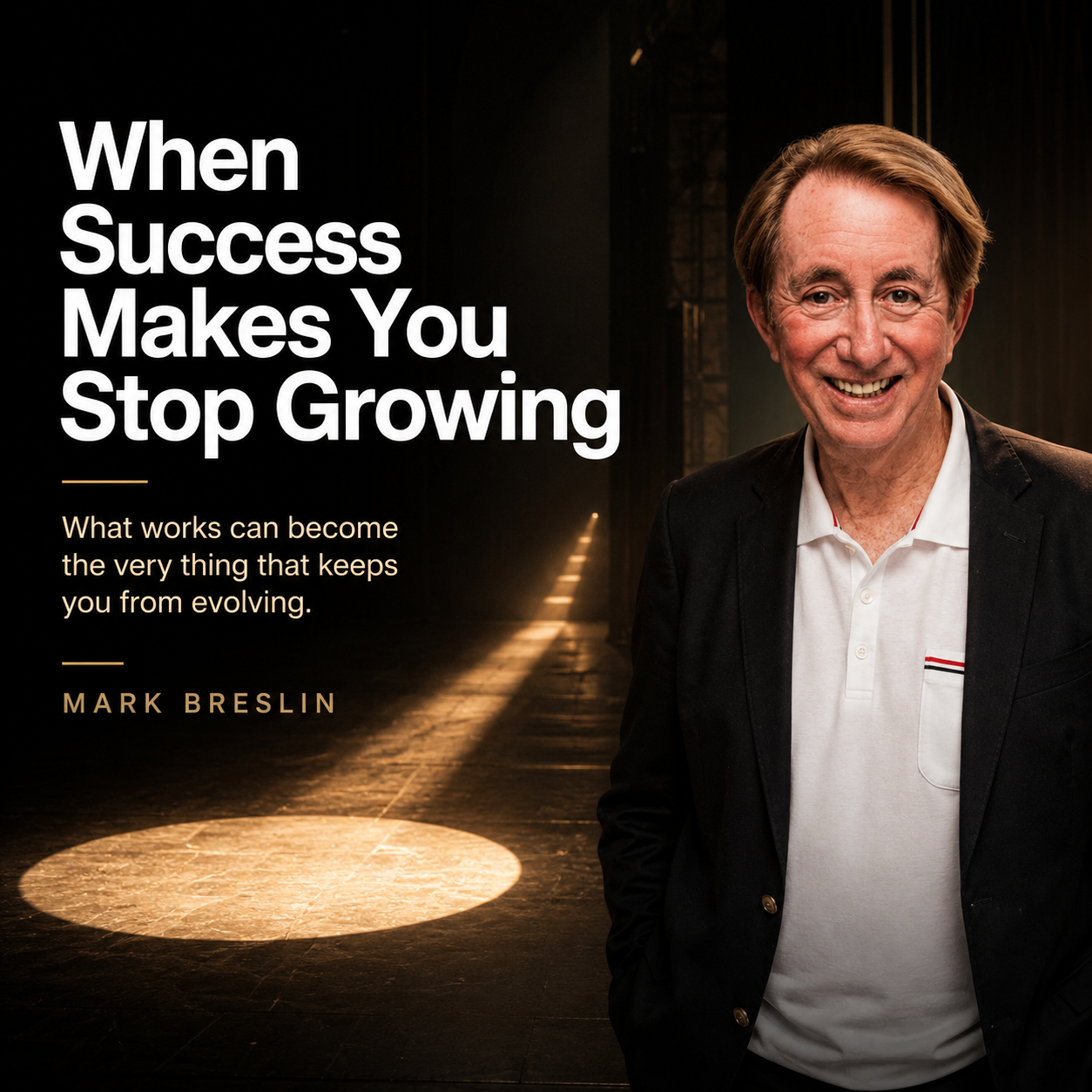
That tension emerged clearly in my conversation with Mark Breslin, the founder of Yuk Yuk’s and one of the most influential figures in Canadian comedy. After spending decades watching comedians develop their craft, Mark has seen what separates those who merely find an act that works from those who continue building meaningful, lasting careers.
His insight extends far beyond comedy: sometimes the greatest threat to our growth is not failure, but becoming too comfortable with success.
Why This Conversation Matters
Success changes the way risk feels.
Before something works, experimentation is necessary. We try different approaches because we have little to protect. We make adjustments, learn through mistakes and keep searching for the combination that will move us forward.
Once we succeed, the emotional equation changes.
Now there are expectations to meet. People know us for something. A certain approach has produced reliable results. The possibility of trying something new no longer feels like ordinary experimentation. It feels like risking the identity, reputation or security we have built.
That can happen to a comedian whose established material consistently earns laughs. It can happen to a leader whose familiar management style has produced strong results. It can happen to an entrepreneur relying on a proven business model, a creator repeating popular content or a person staying within a role that no longer challenges them.
We may still appear productive. We may even remain successful. But growth can quietly slow because our attention has shifted from discovering what is possible to defending what is familiar.
The danger is subtle. Failure is easy to recognize because it hurts. Stagnation after success can feel comfortable, responsible and even wise.
The Trap of Becoming Addicted to What Works
Mark described the experience of developing a comedy act that consistently connects with an audience. The material works. The laughter arrives where expected. The applause confirms that the performer has found something valuable.
Then a new problem appears.
As Mark explained, comedians can become afraid to try fresh material because it may not receive the same response. They become accustomed to the approval produced by the established act. The successful material becomes more than a tool. It becomes a form of protection.
That pattern is not limited to the stage.
When people praise us for doing something well, we naturally want to repeat it. Repetition itself is not the problem. Mastery often requires doing the fundamentals consistently.
The problem begins when success removes curiosity.
Instead of asking, “What else could I learn?” we ask, “How do I make sure nothing changes?”
Instead of wondering whether a new approach could create something stronger, we avoid it because the first attempt may not look as polished as the work we already know how to produce.
Success can raise our standards while lowering our tolerance for being a beginner. We forget that every new level requires us to look uncertain, awkward or imperfect again.
Protecting what works may preserve our current results for a while. It cannot guarantee continued relevance, creativity or growth.
Growth Requires the Willingness to Lose the Applause
Trying something new often means temporarily giving up the feeling of competence.
For a comedian, new material may fall flat. For a leader, a different approach may create uncertainty. For a business owner, a new offering may not immediately attract customers. For anyone attempting to evolve, the early stages can feel uncomfortable because progress is not yet visible.
That discomfort can be especially challenging after success.
Before we have achieved anything, mistakes may feel like part of the process. After we have established ourselves, mistakes can feel like evidence that we are slipping.
Mark’s perspective is grounded in decades of live comedy, where the response is immediate and impossible to hide. A joke either connects or it does not. Performers learn by entering that uncertainty repeatedly, observing what happens and refining their work.
He argued that live performance is essential because experience teaches a person how to respond in different situations. A performer becomes “burnished” through repetition, difficult rooms, failed attempts and the gradual development of judgement.
That same process strengthens us in other areas of life.
Growth does not happen because we avoid moments that challenge our competence. It happens because we remain present long enough to learn from them.
The applause we already know how to earn can become a cage when we are unwilling to risk silence.
Longevity Demands More Than One Successful Formula
Mark has spent 50 years in a business shaped by changing audiences, performers, platforms and cultural expectations. He credited part of that longevity to the fact that the work never remains exactly the same.
“There’s always different people. There’s always different ideas. There’s always different marketing plans,” he said.
That willingness to remain engaged with change matters.
A formula can create an opportunity, but it rarely sustains an entire career without adaptation. Long-term success requires enough confidence to trust what we have learned and enough humility to recognize that what worked before may not always be enough.
Mark’s own story reflects that balance.
Yuk Yuk’s began as a one-night comedy event in the basement of a community centre. There was no grand blueprint. Mark described himself as someone who reacted to opportunities and “surfed the waves as they came in.” Some decisions worked remarkably well. Others did not. An early expansion into Montreal became a costly failure, while later clubs in Ottawa, Niagara Falls, Hamilton and Edmonton demonstrated that the concept could succeed beyond Toronto.
The growth did not come from pretending every decision was correct. It came from continuing to learn after both success and disappointment.
Longevity is not created by finding one answer and defending it forever. It is created by developing the awareness to recognize when an answer must evolve.
Staying Close to the Work
One reason people stop growing is that success can distance them from the very process that made them successful.
They begin managing the reputation instead of practising the craft. They become more interested in appearing accomplished than remaining teachable.
Mark repeatedly returned to the importance of the work itself.
In comedy, he said, writing matters. Awareness matters. Developing a distinctive character matters. Learning how to command a room matters. None of those abilities appear fully formed. They are developed through observation, experimentation and experience.
Even talented comedians may spend years progressing through different stages before they are ready for a major weekend show. Mark does not judge a performer based on one appearance. He watches how the person develops over time.
That long view is important because growth is rarely captured by one result.
One excellent performance does not mean there is nothing left to learn. One poor performance does not erase a person’s potential. The real question is whether the individual continues working, noticing and adapting.
Success becomes healthier when we treat it as evidence of what we are capable of, not proof that we have finished developing.
Lessons for Living Audaciously
Living audaciously does not mean abandoning everything that works simply for the sake of change.
It means refusing to let comfort make every future decision for us.
There is wisdom in protecting what we have built. There is also courage in recognizing when protection has become fear. Sometimes we hold tightly to a proven approach because it remains effective. Other times we hold on because we are afraid that trying something new may expose us as less capable than people believe.
Growth asks us to tell the difference.
We may need to recognize where praise has made us cautious. We may need to reconsider whether consistency has become repetition without curiosity. We may need to practise creating, leading or contributing in ways that do not guarantee immediate approval.
The intentional shift may be small: test one new idea, ask for honest feedback, enter a different room, revise an old approach or allow ourselves to be inexperienced again.
Mark said that living audaciously means living authentically. Authenticity requires more than repeating the version of ourselves that others already accept. It means continuing to explore who we are becoming, even when that evolution surprises people.
Success should expand our willingness to grow, not reduce it.
BOOK CONNECTION
This conversation reminded me of a central idea in Living Your Best Audacious Life Ever: courage is not reserved for the beginning of a journey. We also need it after something starts working. If today’s conversation resonated with you, the book explores how practical reflection and intentional action can help you keep moving beyond comfort and turn inspiration into lasting growth.
CONCLUSION & CALL TO ACTION
Listen to the complete conversation with Mark Breslin on The Audacious Living Podcast for more insight into comedy, creative development, resilience and building a career that can continue evolving over time.
Subscribe and follow the podcast wherever you listen, and share this article or episode with someone who may be ready to risk being a beginner again.
