
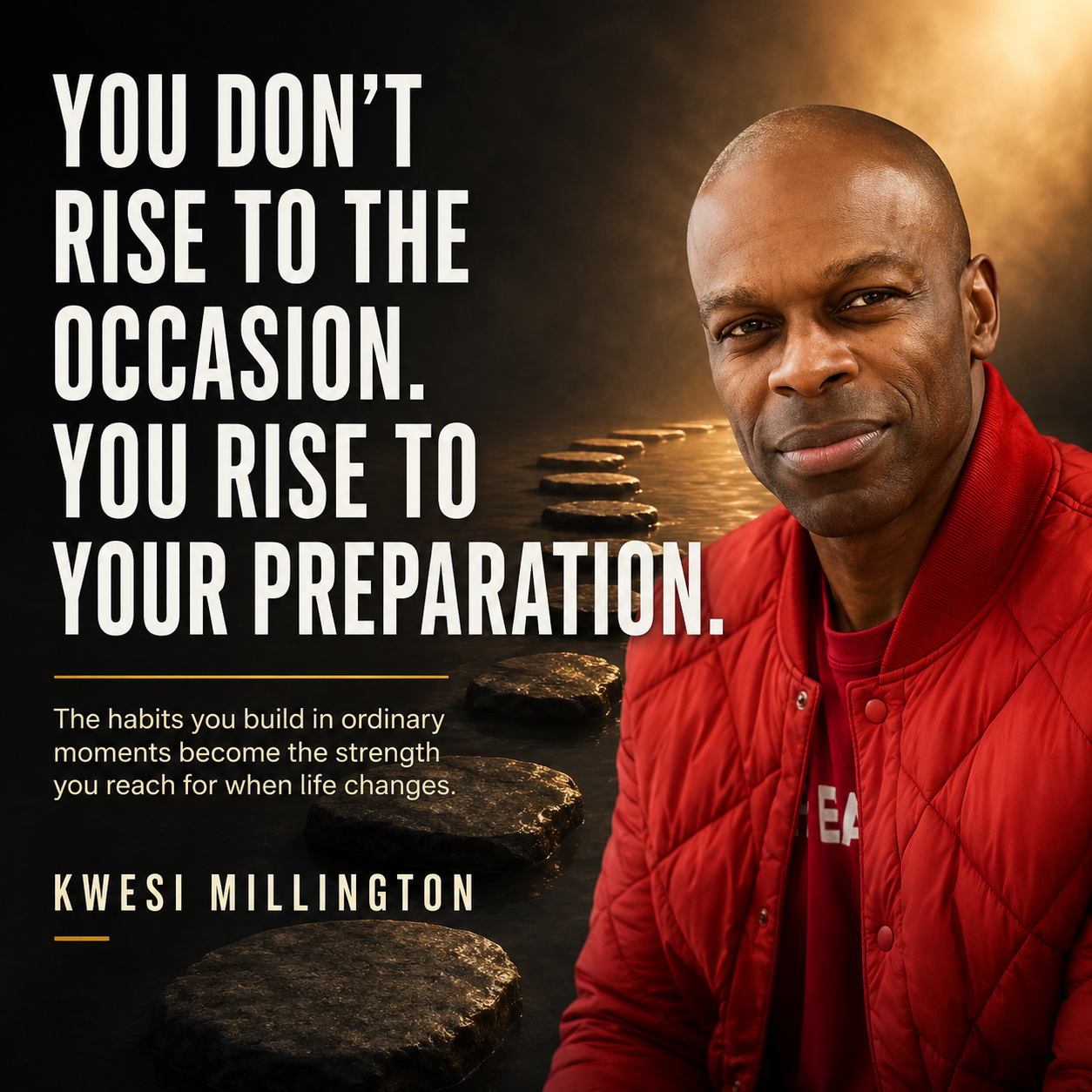
You Don't Rise to the Occasion. You Rise to Your Preparation.
Introduction
We like to believe that when life tests us, something inside will suddenly switch on.
We imagine that pressure will sharpen our thinking, fear will disappear, and courage will arrive right on time. In the big moment, we will simply know what to do.
Sometimes that happens.
More often, the moment reveals what we have already been practising.
That idea came through clearly in my conversation with Kwesi Millington, a professional speaker whose life changed in ways he could never have predicted. Kwesi has lived through public scrutiny, the loss of a career he expected to keep for decades, imprisonment, and the challenge of rebuilding his identity and purpose afterward. His message is not that difficult experiences are easy to overcome. It is that our ability to respond is shaped long before the crisis arrives.
His concept of emotional fitness gives language to something many of us understand only after we need it. Just as physical fitness is built through repeated effort, emotional strength is developed through the habits we practise when life is relatively calm.
Why This Conversation Matters
Most people prepare carefully for the things they want.
We prepare for job interviews, presentations, vacations, competitions, exams, weddings, launches, and opportunities. We research. We rehearse. We create plans and backups.
But we rarely prepare with the same intention for disappointment, uncertainty, loss, criticism, or sudden change.
That is understandable. Nobody wants to spend every morning imagining the worst. Preparing emotionally does not mean expecting disaster or living in fear. It means building habits that help us remain steady when life becomes difficult.
The misunderstanding is that resilience is something certain people naturally possess. We look at someone who survived a major setback and think, “I could never handle that.”
Kwesi pushes back on that assumption. He believes people are often more resilient than they realize and have more influence over that resilience than they think. Daily practices can strengthen our capacity to handle pressure, recover from setbacks, and make thoughtful decisions when emotions are running high.
That matters in everyday life because adversity does not always arrive as one dramatic event.
Sometimes it looks like a difficult conversation you have been avoiding.
Sometimes it is a disappointing email, a financial setback, a change at work, a family challenge, or the slow realization that the life you planned is no longer the life you are living.
The moment may be different for each of us, but the question is the same: What do we reach for when the ground shifts?
Emotional Fitness Is Built on Ordinary Days
Kwesi compares emotional fitness with physical fitness.
You do not go to the gym once and declare yourself permanently fit. Strength develops through repetition. You train when you feel good, not only after you become weak.
Emotional fitness works the same way.
Kwesi describes it as doing things regularly that help you remain centred, manage stress, avoid unhealthy comparison, and deal with whatever life brings. For him, those habits include journalling, prayer, meditation, physical fitness, walking, and creating quiet space.
What makes that idea useful is its simplicity.
You do not need a complicated system. You need practices you trust.
The best time to discover whether journalling helps you process your thoughts is not during the worst week of your life. The best time to build supportive relationships is not after you have isolated yourself. The best time to learn how to pause before reacting is not in the middle of a heated argument.
These habits may appear small, but their value compounds.
A regular walk can become the place where you regain perspective.
A journal can show you patterns you would otherwise miss.
Prayer or meditation can create space between what happened and how you respond.
A trusted person can remind you who you are when circumstances make you forget.
None of these practices removes the challenge. They help you meet it with more of yourself available.
The Moment Reveals the Training
There is a reason athletes repeat the same movements thousands of times.
When the crowd is loud and the pressure rises, there is no time to rebuild technique from the beginning. The body relies on what it knows.
Life does something similar to us.
When stress arrives, we tend to return to familiar patterns. If we practise avoidance, we avoid. If we practise immediate reaction, we react. If we practise reflection, asking for help, and taking one useful step, those options become easier to access.
Kwesi used the image of a tool belt to explain this. Different situations require different tools, but those tools need to be developed before the situation demands them. He encouraged people to make practices like fitness, silence, prayer, meditation, journalling, and supportive relationships part of everyday life rather than emergency measures.
That does not mean we will always respond perfectly.
Preparation is not perfection.
You can have strong habits and still feel afraid. You can be emotionally fit and still feel hurt, angry, confused, or disappointed. Kwesi is honest about the fact that some days are easier than others. Public criticism can still get under his skin, even after years of learning how to manage it.
The goal is not to stop feeling.
The goal is to avoid becoming completely controlled by the feeling.
Preparation gives us choices. It creates enough internal space to ask, “What response will help me move forward?”
Build the Habit Before You Need the Strength
One of the most useful ideas in the conversation was Kwesi’s reminder that these habits matter especially when life is going well.
He journals every day, not because he is always struggling, but because the habit is already there when he needs to lean on it.
That is an important distinction.
We often stop doing the things that support us as soon as we begin to feel better. The difficult season ends, so the journal disappears into a drawer. The walks become less frequent. The phone replaces the quiet time. We become busy again and assume we no longer need the practices that helped us regain our footing.
But emotional fitness is not only recovery. It is maintenance.
It is the same reason we continue exercising after gaining strength. We understand that strength needs attention.
The same is true of perspective, patience, confidence, and emotional steadiness.
A useful starting point is to notice what already helps you return to yourself.
Maybe it is movement.
Maybe it is music, writing, prayer, time outdoors, a conversation with someone grounded, or reviewing previous moments you handled well.
Kwesi and I also discussed the value of tracking wins. We tend to remember failures quickly and overlook evidence of our own progress. Recording even small wins can retrain our attention and remind us that one difficult moment does not erase everything we have already overcome.
Your preparation does not have to look impressive.
It only has to be consistent enough to become available when you need it.
Preparation Helps You Release the Plan
Emotional preparation is not only about managing stress. It also helps us adapt when the future changes.
Kwesi once expected policing to be his lifelong career. He understood the path, the timeline, and what retirement might look like. When that future disappeared, one of the most important things he learned was how to release rigid expectations about what his life was supposed to become.
That kind of release takes strength.
Many of us do not suffer only because circumstances changed. We also suffer because we continue arguing with the fact that they changed.
We hold tightly to the version of life we expected and compare everything happening now with what should have happened instead.
Preparation helps because it builds confidence in our ability to adapt.
It does not tell us that every change is good. It reminds us that change does not remove our ability to respond.
Kwesi eventually found work as a professional speaker and coach, something he says he enjoys even more than the career he once expected to keep. He holds that purpose with gratitude, but also more lightly than before. He has learned that meaningful work can matter deeply without becoming the only identity he is allowed to have.
That is emotional fitness too.
It is knowing who you are without requiring life to follow one exact script.
Lessons for Living Audaciously
Living audaciously is often associated with bold moves, public courage, and visible action.
But some of the most audacious work happens quietly.
It happens when you build a habit nobody applauds.
It happens when you sit with your thoughts instead of escaping them.
It happens when you ask for help before everything falls apart.
It happens when you stop telling yourself that you should already know how to handle every challenge and begin preparing with humility.
Courage in this context is not pretending that you are ready for anything.
It is accepting that life will surprise you and choosing to strengthen your response anyway.
You may need to reconsider the belief that resilience is something you either have or do not have. You may need to recognize that your daily choices are already training you, whether intentionally or not.
The question is not whether you are practising.
The question is what you are practising.
Are you practising panic or pause?
Avoidance or honesty?
Isolation or connection?
Self-criticism or reflection?
One intentional shift can create meaningful progress. Choose one practice that helps you feel grounded and make it part of your ordinary life. Do not wait for the difficult moment to prove its value.
You may not rise magically to the occasion.
But you can meet it with the strength, perspective, and habits you took the time to build.
This conversation reminded me of a principle I explore in Living Your Best Audacious Life Ever: How Unleashing Your Inner Greatness Can Change the World! Audacity is not only the courage to act in a defining moment. It is also the discipline to prepare before that moment arrives. If today’s message resonated with you, the book explores how small, intentional choices can help turn inner potential into lasting action.
Listen to the full conversation with Kwesi Millington on The Audacious Living Podcast for more insight into emotional fitness, resilience, and choosing your response when life changes direction. Subscribe to the podcast, follow the show, and share the episode or this article with someone who may need the reminder that strength is often built long before it is seen.
