
Why Accountability Is the Missing Link Between Goals and Results
Introduction
Most of us do not struggle to identify what we want.
We want to improve our health, complete a meaningful project, build a business, strengthen a relationship or finally act on an idea that has been sitting in the background of our lives.
The problem often begins after the goal has been set.
Initial excitement fades. Life becomes busy. Progress becomes difficult to recognize. A missed day turns into a missed week, and before long, a goal that once felt important becomes another promise we quietly made to ourselves and did not keep.
That gap between intention and action is where accountability matters.
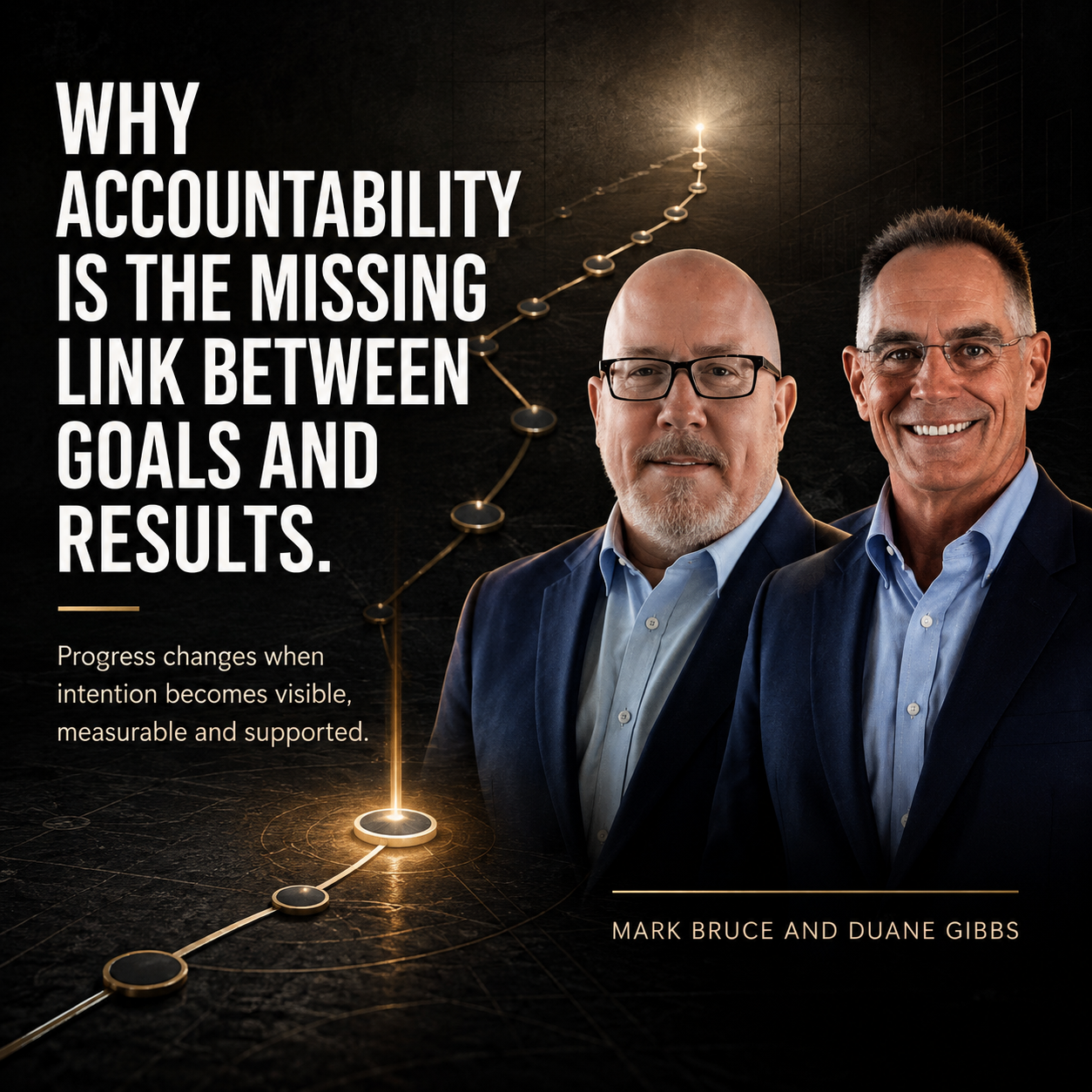
During my conversation with Mark Bruce and Duane Gibbs of Huddle for Success, we explored how external perspective, measurable progress and consistent check-ins can help people move beyond good intentions. Their work is grounded in personal development, coaching, mindset and accountability, with a particular focus on helping people make meaningful progress in their personal and professional lives.
Their message was not that people need more pressure. It was that people often need a clearer way to see what they are doing, where they are improving and where they may be drifting.
Why This Conversation Matters
Goals can create direction, but they do not automatically create movement.
Writing down a goal may help clarify what you want. Visualizing the outcome may strengthen your belief that it is possible. Motivation may even give you enough energy to begin.
But none of those things guarantees consistent action.
This is where many people misunderstand accountability. They see it as someone checking whether they completed a task, questioning their discipline or pointing out what they did wrong.
Effective accountability is not punishment. It is information.
It gives you a more accurate picture of your behaviour. It helps you compare what you said mattered with what you actually did. It also creates an opportunity to make adjustments before a temporary setback becomes a permanent pattern.
Without that feedback, it is easy to confuse activity with progress. We can remain busy, make plans and think constantly about our goals without taking the specific actions that move them forward.
Accountability interrupts that cycle. It replaces assumption with evidence.
You Cannot Always See Clearly From Inside Your Own Life
One of the strongest ideas from the conversation was the value of outside perspective.
Mark shared an experience from a mastermind group in which he was trying to improve his LinkedIn headline. He could offer clear suggestions to everyone else in the group, but he could not solve his own problem. The other members quickly saw what he could not.
As he explained, sometimes we become so closely wrapped around our own thinking and beliefs that we need someone outside the situation to offer another perspective.
That is one reason accountability can be so powerful. It gives us access to a viewpoint we cannot create entirely on our own.
When we are emotionally connected to a goal, we may overlook patterns that would be obvious to someone else. We may underestimate our progress because the finish line still feels far away. We may also exaggerate our effort because we remember how much we thought about the goal rather than how consistently we acted on it.
An accountability partner, coach or trusted group can help separate perception from reality.
That does not mean giving someone else control over your decisions. It means allowing a trusted person to ask questions you may avoid asking yourself.
What did you commit to doing?
What did you actually complete?
What got in the way?
What needs to change before the next check-in?
Those questions are simple, but honest answers can expose the difference between wanting a result and building the habits required to produce it.
Progress Becomes More Powerful When You Can Measure It
Duane described how their clients complete a personal growth scorecard and revisit it every quarter. The scorecard examines several areas of life so clients can see where they are progressing and where they may be declining. Instead of relying on memory or emotion, they have something measurable to review.
This matters because progress is not always dramatic.
Sometimes progress looks like responding more thoughtfully during a difficult conversation. It may mean completing two focused work sessions during a week that once contained none. It could be maintaining a new habit for ten days, making one important phone call or recovering more quickly after a setback.
These changes can be easy to dismiss when we only compare ourselves with the final result.
Measurement gives those small wins visibility.
Duane explained that when clients can see their progress, their attitude, productivity and confidence often begin to rise.
That connection is important. Confidence is not always something we must find before taking action. Sometimes confidence is built by collecting evidence that we are capable of following through.
Each completed action becomes proof.
Each review gives us a chance to recognize that proof.
And each adjustment helps us become more intentional about what happens next.
Accountability Turns Failure Into Useful Feedback
Measuring progress also changes the way we understand failure.
Athletes study game film because memory alone is not enough. They need to see what actually happened. They examine their decisions, timing, positioning and execution so they can make specific improvements.
Duane connected this practice to personal and professional growth, explaining that high-level performers study what went wrong rather than pretending every performance was successful.
The same principle applies to our goals.
Without accountability, a setback can quickly become a judgement about our character.
“I failed because I am not disciplined.”
“I missed the deadline because I am not capable.”
“I stopped because I never finish anything.”
Accountability encourages a more useful response.
What happened?
What can this teach me?
Was the goal unrealistic, or was the plan incomplete?
Did I need more support, clearer priorities or a smaller first step?
Mark described failure as feedback that allows a person to adjust and move closer to success. He and Duane encourage clients to move through mistakes quickly, learn from them and continue forward.
That does not mean celebrating careless decisions. It means refusing to waste the information contained inside an unsuccessful attempt.
When accountability is healthy, failure becomes something to examine rather than something to hide.
Consistency Is Built Through Simple Practices
Accountability does not need to involve an elaborate system.
Mark shared a morning practice of writing down ten things he is grateful for and identifying the six most important actions that will move him toward his goal.
Duane spoke about journalling, a practice he initially resisted but eventually found valuable. Writing helped him organize his thoughts, create greater balance and establish a consistent pattern. He encouraged people to write down their goals, especially those that may currently feel beyond their reach.
These practices work because they make intention visible.
A goal that remains inside your head can change depending on your mood. A written goal gives you something specific to revisit. A weekly check-in gives you a moment to compare your intentions with your actions. A progress tracker makes it harder to pretend that vague effort is producing meaningful movement.
The system should remain simple enough to sustain.
You might record one action each day that supports your goal. You might meet with an accountability partner once a week. You might score your progress monthly in the areas that matter most to you.
The purpose is not to create more administration around your life. It is to create enough structure to help you remain honest, focused and engaged.
Complex systems often collapse under their own weight. Simple practices are easier to repeat, and repetition is what eventually creates results.
Accountability Works Best When It Includes Encouragement
Accountability should challenge you, but it should not leave you feeling smaller.
The most valuable accountability relationships combine honesty with encouragement. They recognize progress without ignoring inconsistency. They ask difficult questions without turning every setback into a personal failure.
Mark and Duane’s partnership reflects this idea. Although they come from different experiences, they bring those perspectives together so clients can receive more than one way of looking at a problem. Mark described masterminds as another form of a team huddle: a place where people gather, consider the next play and benefit from one another’s perspective.
That is a useful way to think about accountability.
A huddle is not the game itself. It is the moment when people pause, review what is happening and decide what to do next.
We all need those moments.
Not because we are incapable of making decisions alone, but because meaningful goals can become difficult to navigate when we are tired, discouraged or too close to the problem.
The right support does not carry you toward the goal. It helps you regain the clarity and confidence to keep moving under your own power.
Lessons for Living Audaciously
Living audaciously requires more than setting an ambitious goal.
It requires the willingness to look honestly at your behaviour, invite perspective and make adjustments when your actions are not producing the results you hoped for.
That kind of honesty takes courage.
It can feel easier to keep a goal private, because no one will know whether we followed through. It can feel safer to avoid measuring progress, because the numbers may reveal that our effort has been inconsistent. It can feel more comfortable to continue using the same approach than to admit it is not working.
But accountability is not evidence that you are weak.
It is evidence that the goal matters enough for you to build support around it.
You do not need someone to control your life or monitor your every move. You may simply need one person who knows what you are trying to accomplish and is willing to ask how it is going.
You may need a notebook that shows whether you are acting consistently.
You may need a weekly pause to review what worked, what did not and what you will do differently.
An audacious goal points toward a possibility. Accountability helps turn that possibility into a practice.
And practice is what eventually creates progress.
Book Connection
This conversation reminded me that inspiration becomes meaningful only when it is followed by intentional action. That principle is central to Living Your Best Audacious Life Ever: How Unleashing Your Inner Greatness Can Change the World! If today’s ideas resonated with you, the book explores how practical frameworks, honest reflection and consistent action can help you turn audacious intentions into lasting change.
To hear more from Mark Bruce and Duane Gibbs about mindset, measurable progress and the value of support, listen to the full episode of The Audacious Living Podcast. Subscribe wherever you listen, follow the podcast for future conversations, and share this article with someone who may need help turning an important goal into consistent action.
