
Why “Good Enough” Might Be the Healthiest Mindset You Can Adopt
There is a point where wanting to do something well quietly becomes needing to do it perfectly.
At first, the difference can be hard to notice. You care about the result. You want to improve. You believe there might be a better way, so you keep adjusting, learning and pushing.
None of that is inherently unhealthy.
The problem begins when improvement stops helping you move forward and starts convincing you that what you have already done is never enough.
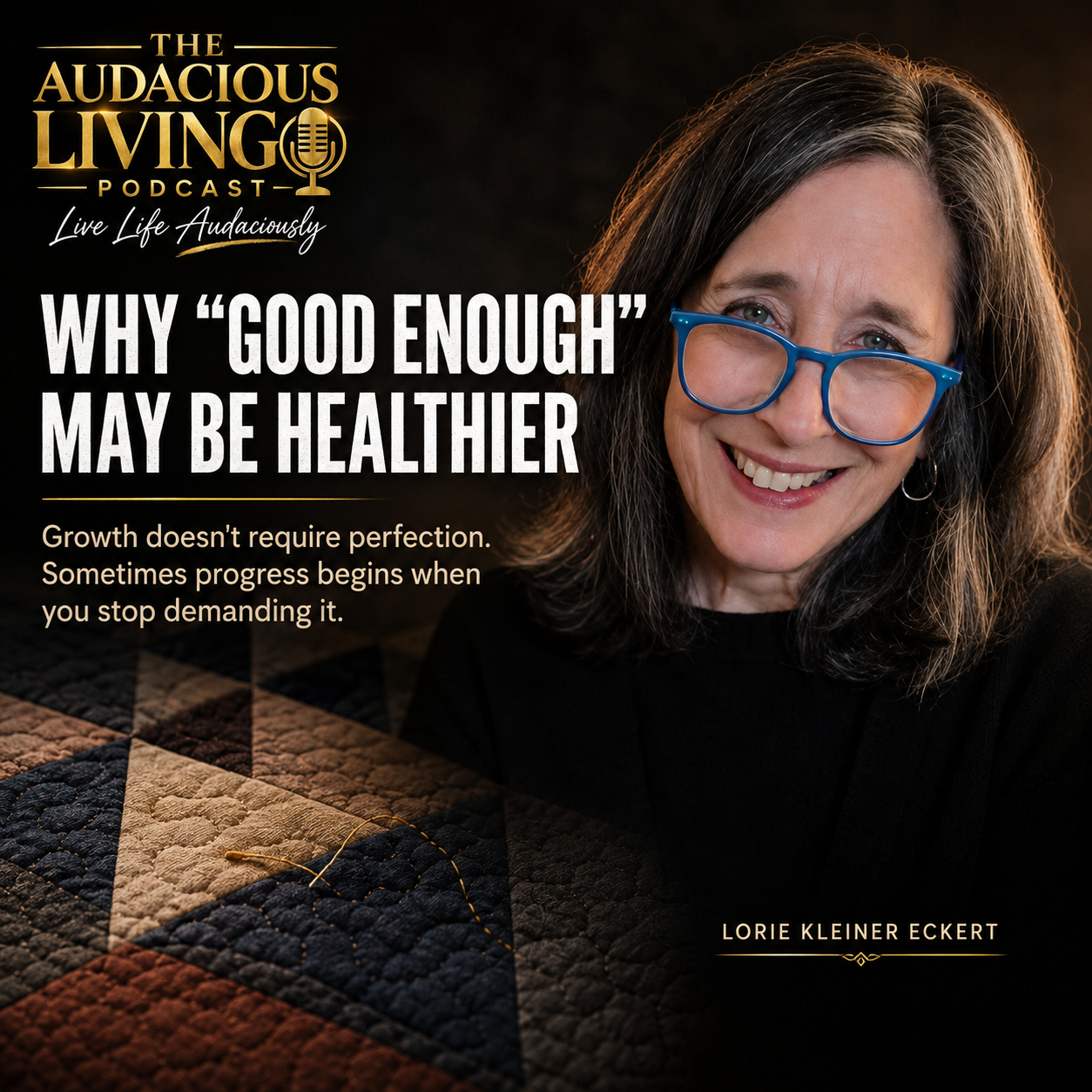
That tension emerged in my conversation with author, storyteller and longtime motivational speaker Lorie Kleiner Eckert. For more than 30 years, Lorie has used stories from her own life to explore reinvention, gratitude, self-acceptance and personal growth. Her latest book, Chai on Life, continues that tradition.
One of those stories carries a deceptively simple message:
“Good enough is good enough.”
For Lorie, this isn't a lesson she claims to have mastered. In fact, she readily admits that she may be the person who needs to hear it most.
Maybe that's what makes the idea worth examining.
Why This Topic Matters
Perfectionism can disguise itself as ambition.
It can sound responsible: I just want to get it right.
It can look productive: another revision, another improvement, another attempt to find the absolute best method.
And striving for excellence can be valuable. Wanting to learn, improve and stretch yourself is part of growth.
But there is an important distinction between using improvement to sharpen yourself and allowing perfection to immobilize you.
That distinction became one of the most interesting parts of my conversation with Lorie. I suggested that the desire to improve can have two sides. It can encourage continuous growth, but it becomes a problem when the pursuit of something better prevents you from making progress at all.
That is where “good enough” becomes more than settling.
Sometimes it becomes permission to continue.
When Better Makes Everything Harder
Lorie illustrates the danger of perfectionism with something wonderfully ordinary: chicken soup.
For years, she had made it the same way. Chicken, water, onions, carrots, celery and seasoning went into a pot and cooked for a couple of hours. Sometimes it came out wonderfully. Sometimes it tasted more like hot water, and she would add soup granules to improve it.
Then she encountered what appeared to be a superior method.
The new recipe involved cutting chicken legs into small pieces, browning them, waiting for them to release their juices, cooking everything carefully, straining the mixture and then dealing with all those little pieces afterward.
The soup was delicious.
It was also so complicated and time-consuming that Lorie reached an unexpected conclusion:
She didn't want to make chicken soup anymore.
There is something wonderfully human about that story.
The original soup wasn't perfect. Occasionally it needed some help. But it existed. People ate it. Life continued.
The improved version may have produced a better bowl of soup, but if the process becomes so exhausting that you stop making soup altogether, what exactly have you gained?
We encounter versions of this everywhere.
A workout routine becomes so demanding that we abandon exercise.
A creative project becomes so carefully planned that we never publish it.
A new idea gets researched, reorganized and refined until the original excitement disappears.
Sometimes the healthiest question isn't, Could this be better?
Of course it could.
The more useful question may be, Is this good enough to keep me moving?
Progress Should Not Require Perfection
Lorie encountered the same lesson through quilting.
As an accomplished quilter, she once read another professional quilter's suggestion that if using ten fabrics was good, using 100 would be even better.
So she tried it.
Instead of improving her enjoyment of quilting, the added complexity made something she already knew how to do feel unnecessarily difficult. Eventually, she found herself thinking that perhaps she didn't want to make quilts anymore either.
That is an important warning.
There will almost always be another method.
Another expert.
Another strategy.
Another standard against which you can measure what you're doing.
If your definition of success keeps moving every time you discover someone else's version of “better,” satisfaction becomes almost impossible.
This does not mean ignoring expertise or refusing to learn.
It means remembering that improvement should serve the work rather than make you afraid of it.
The healthiest growth gives you more capacity to continue. It doesn't constantly produce evidence that you are inadequate.
“Good Enough” Does Not Mean Giving Up
This may be the hardest part of the idea to accept.
“Good enough” can sound like lowering your standards.
But perhaps the better distinction is between perfection and progress.
During our conversation, Lorie described her approach to reinvention as taking “one tiny step a day.” She acknowledged that some of those steps will be missteps or sideways steps.
That is what real progress often looks like.
Not flawless.
Not linear.
Not impressive every day.
Just moving.
There is still room to make tomorrow's version better than today's. There is still room to learn from what didn't work. There is still room to care deeply about quality.
What changes is the expectation that you must have everything figured out before today's step counts.
“Good enough” gives you somewhere to stand while you continue becoming better.
Give Yourself Credit Along the Way
Perfectionism has another cost: it can make accomplishments strangely difficult to enjoy.
Once something is finished, the mind immediately identifies what could have been different or what should happen next.
Lorie's reflections on praise offered an interesting counterweight to that tendency. Growing up, she said her parents worried that too much praise might give their children “swelled heads.” As a parent herself, Lorie chose differently. Her reasoning was simple: if she didn't tell her children when they had done something well, how would they know?
That idea reaches beyond parenting.
We need to recognize our own progress too.
During the conversation, I described my own belief in celebrating the things we accomplish because those moments become evidence we can draw upon later. When life becomes difficult, it helps to remember that we have already faced things we once doubted we could handle.
Perfectionism keeps pointing toward the gap.
Healthy progress occasionally turns around and notices the distance already travelled.
Both perspectives matter.
But if you only look at what's missing, you may never recognize what's working.
Lessons for Living Audaciously
Living audaciously doesn't require getting everything right.
Sometimes it requires the courage to release something before every corner has been polished.
Sometimes it means trusting the work you have already done.
Sometimes it means learning another lesson Lorie shared: “a little bit plus a little bit equals a whole lot.”
Tiny steps accumulate.
Imperfect attempts teach us.
Completed work gives us something to improve.
And mistakes can become information rather than indictments.
There is nothing wrong with wanting to become better. Keep learning. Keep stretching. Keep sharpening yourself.
Just don't let your vision of what something could eventually become convince you that what you can do today has no value.
Your next step doesn't have to be perfect.
It just has to be enough to make the next step possible.
