
Stop Trying to Change People. Start Trying to Understand Them
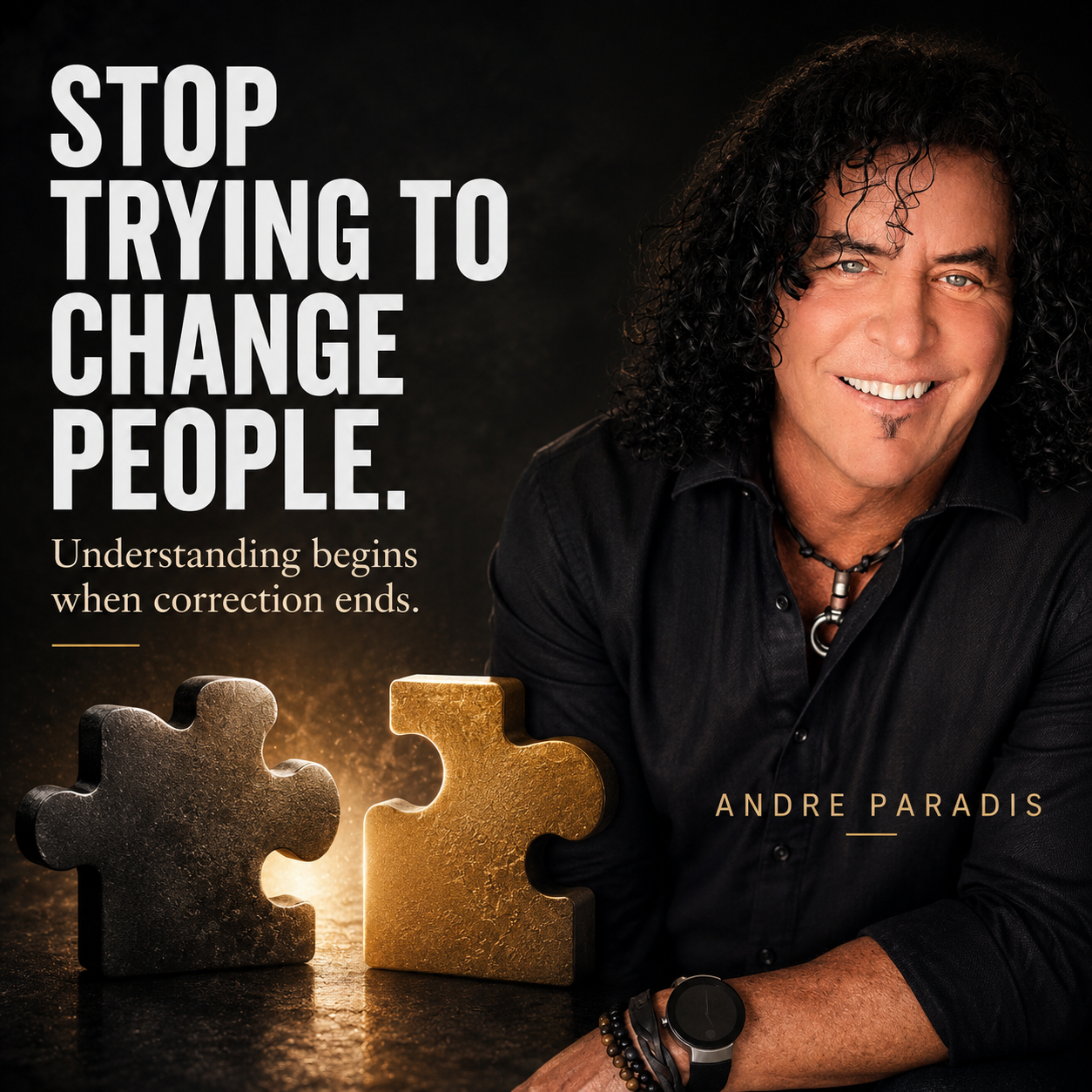
One of the strangest things about relationships is how easily the qualities that once fascinated us about someone can eventually become the very things that frustrate us.
Maybe you're spontaneous and they're a planner. You're ready to talk everything through immediately and they need time to process. You recharge by being around people while they'd happily spend Saturday morning alone with a coffee and nowhere to go.
At first, those differences can feel interesting. Refreshing, even.
Then somewhere along the way, we start thinking: Why can't you just do this the way I do it?
And without necessarily realizing it, understanding gets replaced by correction.
That tension was at the heart of my conversation with relationship coach and former professional dancer Andre Paradis. His perspective is certainly provocative at times, particularly around differences between men and women, but underneath it is an idea with much broader application: we create unnecessary conflict when we assume that different automatically means wrong.
Andre put it simply when discussing couples who discover how different they are: "It's not about changing the other person." The more useful challenge, he suggested, is figuring out how to embrace those differences and "dance that together."
Why This Topic Matters
We don't only try to change people in romantic relationships.
We do it with our children, colleagues, friends and family members.
We want the quiet person to speak up. We want the talkative person to get to the point. We want the cautious person to move faster and the spontaneous person to think things through.
Sometimes change really is necessary. Harmful behaviour shouldn't simply be accepted in the name of understanding. Boundaries matter. Accountability matters.
But there's an important distinction between asking someone to address behaviour that hurts a relationship and wanting them to become more like us simply because their way makes less sense to us.
Andre illustrated this with a couple who believed their differences meant they were incompatible. One wanted to sleep late on Saturday morning, drink coffee and relax. The other wanted to be up at six and hit the hiking trail. Andre saw something different. Instead of treating their preferences as evidence the relationship couldn't work, he encouraged them to recognize what each person's world could add to the other's.
That's a useful shift.
Difference doesn't automatically equal deficiency.
Sometimes it's simply difference.
We Take More Personally Than We Realize
A behaviour happens.
Then we create a story explaining why it happened.
That's where things get interesting.
Someone doesn't respond to your message quickly enough.
They're ignoring me.
Your partner is distracted while you're talking.
They don't care about what I'm saying.
A colleague questions your suggestion.
They don't respect me.
The behaviour may be real. Our interpretation of it may not be.
During our conversation, I shared an example from one of my own relationships. If an idea came to me, I would sometimes reach for my phone because I wanted to capture it before I forgot it. To me, I was recording an idea. To my partner, my attention had suddenly left the person sitting right in front of me.
Same action.
Two completely different experiences of it.
That's important because our interpretation determines what happens next.
If I believe you're deliberately disrespecting me, I'm likely to respond defensively. If I become curious about what you're actually doing, there's room for a very different conversation.
Understanding doesn't require excusing behaviour.
It means becoming curious before becoming certain.
Understanding Changes the Conversation
Andre repeatedly returned to the practical importance of learning how another person communicates.
He described something as simple as being deeply focused on writing while his wife wanted his attention. Earlier in their relationship, an interruption could create frustration. Over time, she learned to give him a moment to finish what he was doing, and he could then turn his attention fully toward her.
The point isn't that everyone should adopt their particular arrangement.
It's that they learned something about each other.
That's fundamentally different from saying, You need to stop being this way.
Once you understand why someone behaves a certain way, you have more choices about how to respond.
Instead of:
Why are you like this?
The question becomes:
What am I missing here?
Instead of:
You should know what I need.
It becomes:
Have I actually communicated what I need?
And instead of assuming:
If you cared, you'd do this naturally.
We can ask:
Could this person care deeply and still express it differently than I do?
Those questions create room.
And sometimes room is exactly what a relationship needs.
The Goal Isn't Sameness
Andre's background gives him an unusually visual metaphor for relationships.
Before becoming a relationship coach, he spent about 15 years as a professional dancer. Ballroom dancing taught him something important about partnership: two people can create one coordinated movement while still contributing differently to it.
I love the broader principle behind that image.
Watch two great dancers and you don't see one person trying to turn the other into a copy of themselves.
You see awareness.
Adjustment.
Trust.
Response.
Movement.
Each person remains an individual, but they're paying attention to what's happening between them.
Relationships can work the same way.
The goal isn't necessarily to think alike.
It's learning how to work with what each person brings.
That applies to friendships and workplaces too. A visionary may need someone who notices details. A fast decision-maker may benefit from someone who asks another question. An extrovert may help an introvert step into new experiences while the introvert creates space for greater reflection.
Those differences can create conflict.
They can also create balance.
The deciding factor is often whether we approach difference with judgement or curiosity.
Past Experiences Can Distort the Present
There's another layer to this.
We're rarely responding only to what's happening right now.
We bring history with us.
During the interview, I raised this with Andre because past experiences can teach us valuable lessons while simultaneously creating assumptions that limit future relationships. If you've repeatedly been disappointed or betrayed, for example, you may enter the next relationship expecting the same outcome.
Andre's work places significant emphasis on early experiences and the beliefs people develop from them. He argues that those beliefs can create patterns in which people repeatedly interpret present experiences through old expectations.
Whatever weight we place on his specific framework, the broader question is worth considering:
Am I responding to this person, or am I responding to everyone who came before them?
Sometimes someone else's difference isn't actually the problem.
It's what their difference triggers in us.
Maybe their need for space reminds you of someone who abandoned you.
Maybe their direct communication reminds you of someone who constantly criticized you.
Maybe their independence feels like rejection because you've learned to associate closeness with constant contact.
Understanding another person therefore sometimes requires understanding ourselves first.
Otherwise, we can spend years trying to change someone else when part of the work belongs to us.
Lessons for Living Audaciously
There's courage involved in allowing people to be different from us.
Control feels safer.
If everyone thinks the way we think, communicates the way we communicate and behaves the way we expect, there are fewer surprises.
But that's not how human beings work.
Living audaciously within our relationships means having enough confidence in who we are that another person's differences don't automatically threaten us.
It means being willing to say, Help me understand.
It means recognizing the difference between a boundary and a preference.
It means noticing when we're trying to correct someone's personality rather than address an actual problem.
And sometimes it means accepting that understanding won't produce agreement.
That's okay too.
Andre's dance metaphor offers a useful way of thinking about it. The objective isn't to erase two individuals and create one identical person. It's learning how to move together without constantly stepping on each other's feet.
That requires communication.
It requires curiosity.
And occasionally it requires admitting that the person we've been trying so hard to change may not actually need changing.
Maybe we need to learn their rhythm.
Conclusion
My conversation with Andre Paradis goes much deeper into relationships, communication and the differences that shape how we connect with one another. His perspectives may challenge you, and that's part of what makes the conversation worth hearing.
Listen to the full episode of The Audacious Living Podcast, subscribe wherever you listen, and if this article made you think about someone differently, share it with them.
Sometimes understanding begins with a conversation.
