
Stop Trying to Change People. Start Trying to Understand Them
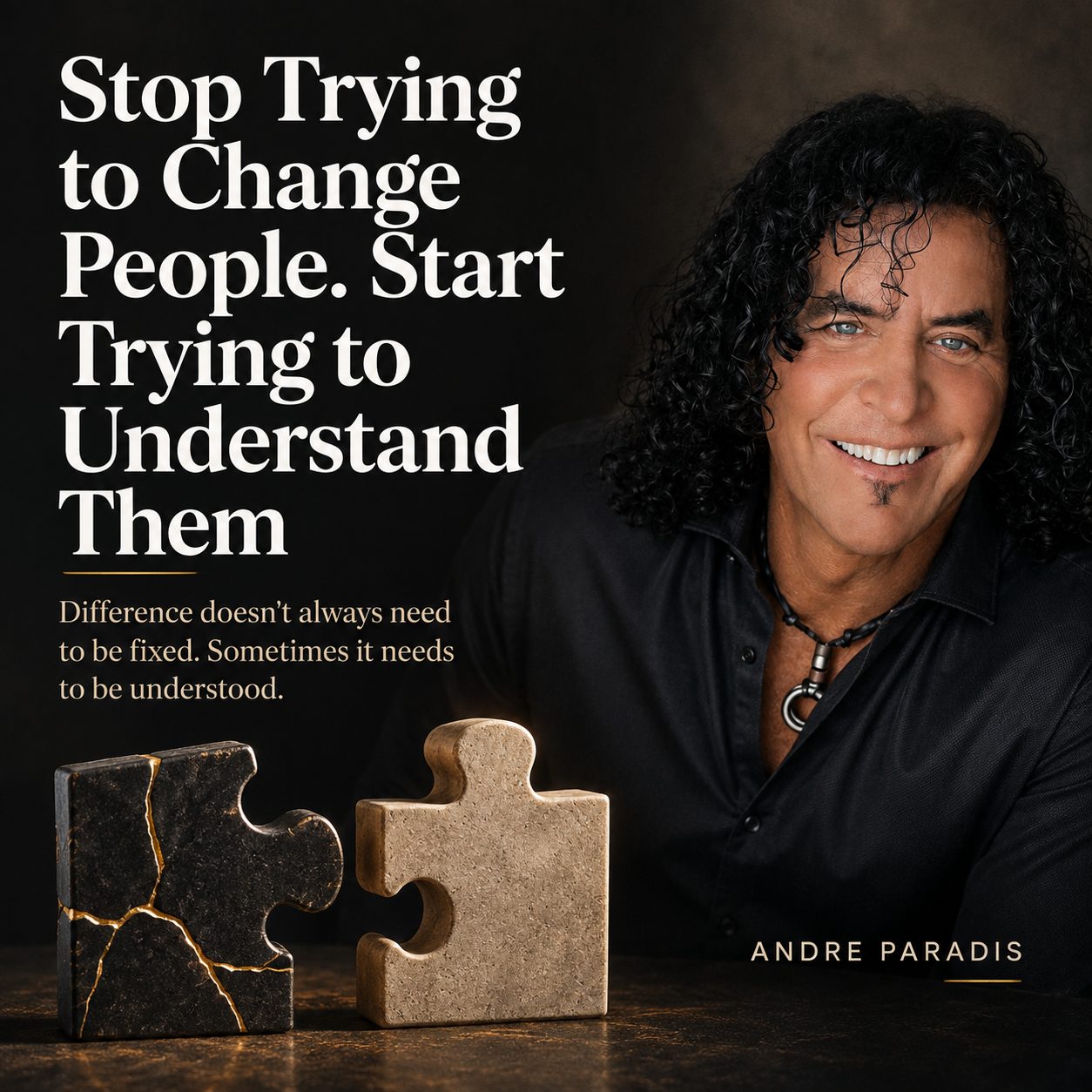
There is a subtle shift that can happen in almost any relationship.
At first, someone's differences are interesting. They intrigue us. They expose us to another way of thinking, communicating or experiencing the world.
Then, somewhere along the way, those same differences can start getting on our nerves.
The person who was spontaneous becomes unpredictable. The person who was thoughtful becomes too quiet. The person who loved talking becomes exhausting. The independent thinker we admired suddenly seems stubborn.
Without realizing it, we can begin treating difference as deficiency.
We stop asking, Why might this person see things differently? and start wondering, Why can't they just see it my way?
That tension was at the heart of my conversation with relationship coach Andre Paradis on The Audacious Living Podcast. Andre's perspective on relationships is shaped by years of studying human behaviour, but it is also influenced by an unusual background: before becoming a relationship coach, he spent 15 years as a professional dancer.
And one of the most useful metaphors he brought into our conversation came directly from the dance floor.
Relationships don't require two people to move exactly the same way.
They require two people to learn how to move together.
Why This Topic Matters
Most of us understand intellectually that people are different. Living with those differences is another matter.
We communicate differently. We process emotions differently. We solve problems differently. We need different amounts of conversation, space, structure, spontaneity and connection.
The difficulty begins when we interpret those differences through our own operating system.
If I need to talk something through immediately, your need for time to process may feel like avoidance. If I naturally focus intensely on one task, your attempt to connect with me at that moment may feel like an interruption. If I enjoy planning everything in advance, your spontaneity may feel irresponsible rather than simply different.
Andre repeatedly returned to this problem in our conversation: we can assign meaning to another person's behaviour without first understanding what is actually driving it.
Once that happens, frustration becomes personal.
You don't listen.
You don't care.
You're too emotional.
You're too distant.
Why can't you be more like me?
But understanding offers another possibility.
It allows us to become curious before becoming critical.
Difference Is Not Automatically Incompatibility
One of Andre's most interesting observations came from a conversation he had with a man going through an amicable divorce.
The man explained that he and his wife had discovered they were complete opposites.
Andre's response was essentially: that's the point.
He described how couples are often drawn to differences in the beginning. One person may be introverted while the other is extroverted. One saves while the other enjoys spending. One loves adventure while the other is happiest at home.
Andre believes those differences can create an important dynamic within relationships. The problem isn't necessarily that the differences exist. The problem begins when people start resenting them and trying to turn their partner into a version of themselves.
He put it beautifully:
“It’s not about changing the other person... How do you embrace the differences? How do you dance that together?”
That's a very different relationship question.
Instead of asking how to eliminate the difference, we ask how to navigate it.
That doesn't mean every difference is healthy, acceptable or sustainable. Boundaries still matter. Values matter. Respect matters. There are behaviours that should not simply be tolerated under the banner of acceptance.
But many everyday frustrations aren't questions of right and wrong.
They're questions of difference.
And learning to recognize the distinction can change the entire conversation.
Curiosity Creates Room for Understanding
One of the quickest ways to create conflict is to assume we already understand someone's motivation.
They didn't call, so they don't care.
They're quiet, so they're angry.
They want to talk, so they're being demanding.
They need some space, so they're pulling away.
The behaviour may be real. Our interpretation of it may not be.
Andre used an example from his own marriage. When he is deeply focused on writing or working on one of his cars, he can become intensely absorbed in what he is doing. An interruption can frustrate him because his attention is completely engaged.
His wife learned not to interpret that concentration as rejection. Instead, she might wait until he reaches a natural stopping point before starting the conversation.
And Andre has had to understand her needs as well. He described learning to intentionally reconnect when arriving home, rather than immediately disappearing into his own routine. Even a short conversation about her day could create a sense of connection before he moved on to whatever he wanted to do next.
Neither person has to become the other.
Both have to become more aware.
That's where curiosity becomes powerful.
Instead of Why do you always do that?, perhaps the better starting point is:
Help me understand what is happening for you.
Understanding doesn't automatically mean agreement.
It simply means we resist the temptation to judge something before we understand it.
Stop Keeping Score and Start Learning the Dance
Andre's years as a dancer gave him an interesting framework for thinking about relationships.
Ballroom dancing, he explained, is a partnership. Two people are participating in the same dance, but they aren't performing identical movements.
Each person contributes something different.
If both people fight to control every movement, they collide.
Andre even teaches this concept by putting couples into a dance frame. He says people's relationship habits can quickly become visible: hesitation, control, resistance, uncertainty and trust can show up physically in how they attempt to move together.
The metaphor extends well beyond romantic relationships.
Think about families.
Friendships.
Workplaces.
Leadership teams.
How often do conflicts escalate because we are trying to prove whose way is correct rather than figuring out how our different approaches can work together?
Sometimes we become so committed to being understood that we stop trying to understand.
That's when relationships become competitions.
The objective becomes winning the argument rather than strengthening the connection.
A good dance doesn't require sameness.
It requires awareness, communication and adjustment.
Understanding Requires Better Communication
Accepting differences doesn't mean silently tolerating everything someone does.
Andre made an important distinction here.
Differences still have to be negotiated.
If something your partner does genuinely affects you, the solution isn't to bury the frustration. It's to communicate without immediately attacking the other person's character.
Andre suggested language that moves away from accusation and toward conversation: when you do something, here's how it affects me. Can we talk about it?
Simple? Yes.
Always easy? No.
Because our ego often wants to build a case.
We collect evidence. We remember the previous argument. We assume intention. Then instead of discussing one behaviour, we put the entire person on trial.
Understanding asks something more difficult of us.
It asks us to separate the person from the behaviour.
It asks us to listen for information that might challenge the story we've already created.
And sometimes it asks us to consider the uncomfortable possibility that the other person isn't the only one who needs to adjust.
The Person in Front of You Has a History
Our reactions don't begin with the present moment.
Andre and I also talked about how past experiences can shape the way we interpret current relationships. Experiences of disappointment, rejection or broken trust can influence what we expect from people later.
The challenge is that yesterday's experiences can quietly become today's assumptions.
Andre described this as a kind of loop: our beliefs can influence what we notice, whom we choose and how we interpret what happens to us.
That's another reason understanding matters.
When someone reacts strongly to something that seems insignificant to us, we may only be seeing the current moment. They may be experiencing it through years of previous experiences.
That doesn't excuse harmful behaviour.
But context can create compassion.
And sometimes the person whose history we need to understand isn't the other person.
It's ourselves.
Why does this behaviour bother me so much?
What am I assuming?
What story am I attaching to what happened?
Am I responding to this person, or am I responding to everyone who disappointed me before them?
Those are difficult questions.
They're also powerful ones.
Lessons for Living Audaciously
We often associate audacity with speaking up, taking risks, pursuing ambitious goals or refusing to settle.
But there is another kind of audacity.
The audacity to become curious when you'd rather be right.
The audacity to listen without immediately preparing your defence.
The audacity to recognize that someone doesn't have to think, communicate or experience life exactly as you do to have something valuable to contribute.
And perhaps most importantly, the audacity to examine your own assumptions.
Understanding people doesn't require abandoning your standards or accepting harmful behaviour. It means becoming intentional about distinguishing between something that is genuinely wrong and something that is simply different.
Andre's dance metaphor offers a useful way to remember that.
You don't create a beautiful dance by forcing the other person to become you.
You pay attention.
You communicate.
You adjust.
You learn each other's rhythm.
And somewhere in that process, difference can stop feeling like something that needs to be fixed and become something you can learn how to work with.
