
Why Reinvention Feels Messy — and Why That’s a Good Thing
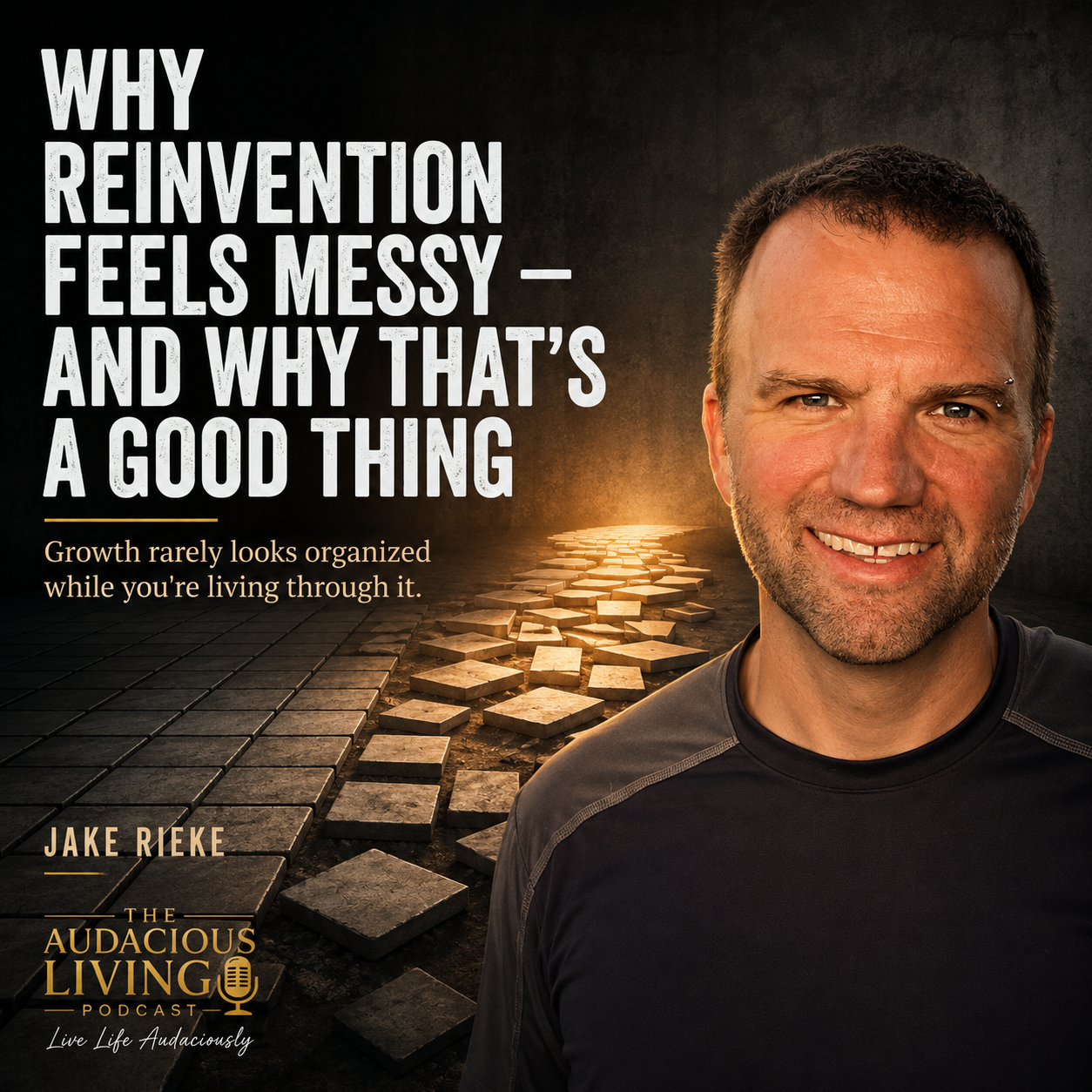
We tend to admire reinvention once the messy part is over.
We see the new career, healthier lifestyle, stronger relationship or completely different direction and say, “Wow, look at what they did.”
What we don't always see is everything between the old life and the new one.
The uncertainty. The second-guessing. The relationships that change. The habits that fight back. The uncomfortable realization that something which once made sense no longer does.
That space can feel like something has gone wrong.
But what if the mess is actually evidence that something is changing?
That idea came through clearly in my conversation with Jake Rieke. Jake and his family underwent a significant personal reinvention, eventually leaving a fifth-generation Minnesota farm with roughly 150 years of family history behind and building a very different life in Costa Rica.
What makes his story interesting isn't simply the size of the change.
It's what happened in between.
Why This Topic Matters
Change sounds exciting until it starts disturbing things.
We say we want growth, but growth has a habit of asking uncomfortable questions.
Is this still working?
Do I actually believe this?
Am I doing this because I want to, or because I've always done it?
Who might be disappointed if I change?
Jake described how generations of beliefs had accumulated around the family farm. Some had served previous generations well. But he and his wife began realizing that certain beliefs no longer aligned with the life they wanted.
That's an important distinction.
Outgrowing something doesn't necessarily mean it was wrong.
A belief can have served you beautifully at one stage of your life and become restrictive at another.
A relationship can change.
A career can stop fitting.
A definition of success can evolve.
And sometimes the emotional resistance we experience isn't proof that we're making a mistake. It may simply be what happens when something familiar is being challenged.
Growth Can Feel Like Losing Before It Feels Like Becoming
We often talk about reinvention in terms of what we gain.
What Jake's experience highlights is how much it can also involve letting go.
He described the process of leaving the family farm as taking years rather than happening through one dramatic decision. Becoming the people capable of stepping into a different life meant examining beliefs, relationships and an identity that had developed over generations.
That's where reinvention gets uncomfortable.
You can know that something needs to change and still grieve what you're leaving.
You can be excited about your future and still miss parts of your past.
You can make the right decision for yourself and still feel guilty about disappointing somebody.
Jake spoke candidly about that emotional toll. When he and his wife wanted to take the family business in a different direction, their ideas collided with long-established beliefs. The disappointment that followed, he said, “hit hard like a ton of bricks.”
That's a side of growth we don't celebrate very often.
But perhaps we should at least acknowledge it.
Choosing differently can create friction precisely because the old version of your life had roots.
The discomfort doesn't automatically mean turn back.
Sometimes it means you're actually moving.
Reinvention Doesn't Follow a Clean Script
Toward the end of our conversation, I asked Jake what he thought people misunderstood about reinvention.
His answer was wonderfully uncomplicated:
“It's messy.”
He went on to explain that it doesn't happen overnight and, no matter how clear the vision in your head might be, it is unlikely to unfold exactly as expected.
I think that's liberating.
We put tremendous pressure on ourselves to have change figured out before we begin.
We want the five-year plan.
We want guarantees.
We want to know the decision will work before making it.
Real life rarely cooperates.
Jake and his wife considered several possibilities after deciding to leave their old life. Colorado. Texas. Nashville. Going back to school.
Costa Rica initially lived somewhere in the category of “maybe someday.”
Then they questioned that assumption too.
Why someday?
Why couldn't Costa Rica be an option now?
Eventually, they moved there with their children and began creating a completely different rhythm of life.
They didn't begin with a perfect script.
They began by becoming willing to reconsider what was possible.
That's a very different way of looking at reinvention.
You don't necessarily need to know the ending.
You need enough clarity to take the next meaningful step.
Small Actions Make Big Change Less Overwhelming
A dramatic transformation can make us believe dramatic action is required from day one.
Jake's fitness story suggests otherwise.
At one point, he weighed roughly 232 to 240 pounds and wasn't someone who exercised regularly. Instead of creating an elaborate fitness plan, he started with something almost boringly manageable:
15 minutes on the treadmill.
He repeated it.
Eventually 15 minutes became a mile. A mile gradually became more. Over time he was running three or four miles, and the behaviour no longer required the same mental negotiation because it had become part of his routine.
His conclusion was simple:
“Focus on the habit. First, the habit matters more than anything else.”
That matters because reinvention can become paralysing when we stare only at the final destination.
New career.
New business.
New relationship with yourself.
New way of living.
Those are enormous concepts.
Today's action doesn't have to be enormous.
Sometimes the most meaningful evidence of change is simply doing something today that the old version of you wouldn't have done.
Then doing it again tomorrow.
You Get More Than One Shot
One of my favourite moments in the conversation came when Jake talked about the pressure we place on ourselves to get change right immediately.
He said:
“You've got unlimited shots at goal.”
Then he added:
“The only thing that is failure is if you quit trying.”
Now, you know the basketball guy in me appreciates a good shots-at-goal analogy.
But there's something deeper there.
Reinvention becomes frightening when we treat every decision as permanent.
What if this doesn't work?
What if I choose incorrectly?
What if I have to change direction again?
Maybe you will.
That's not necessarily failure.
Jake talked about reframing frustration as something that can help us grow. The gap between where we are and where we want to be can frustrate us, but it can also provide energy for learning and change.
You take a shot.
You learn.
You adjust.
You take another.
The goal isn't flawless reinvention.
It's continued movement.
Lessons for Living Audaciously
Living audaciously doesn't mean changing everything simply because you're uncomfortable.
It means being willing to investigate the discomfort instead of automatically running from it.
Maybe something needs to change.
Maybe a belief needs another look.
Maybe an old identity has become too small.
Maybe you need to take one small action rather than waiting for complete certainty.
And maybe the mess you're experiencing isn't evidence that you're failing at reinvention.
It could be evidence that you're actually in it.
Jake ultimately described living audaciously as “living with intention.” He contrasted that with falling into a Groundhog Day existence where life simply repeats itself without conscious choice.
That may be the most useful place to land.
Reinvention isn't primarily about becoming somebody impressive.
It's about becoming more intentional about who you're becoming.
Courage might look like leaving something significant.
But it can also look like sitting quietly long enough to admit that something isn't working.
It can look like changing a habit.
Having an uncomfortable conversation.
Trying something and discovering it wasn't right.
Taking another shot.
Messy?
Absolutely.
But meaningful growth usually leaves a few things out of place while you're rearranging your life.
