
Why Self-Awareness Is the First Step to Living an Audacious Life
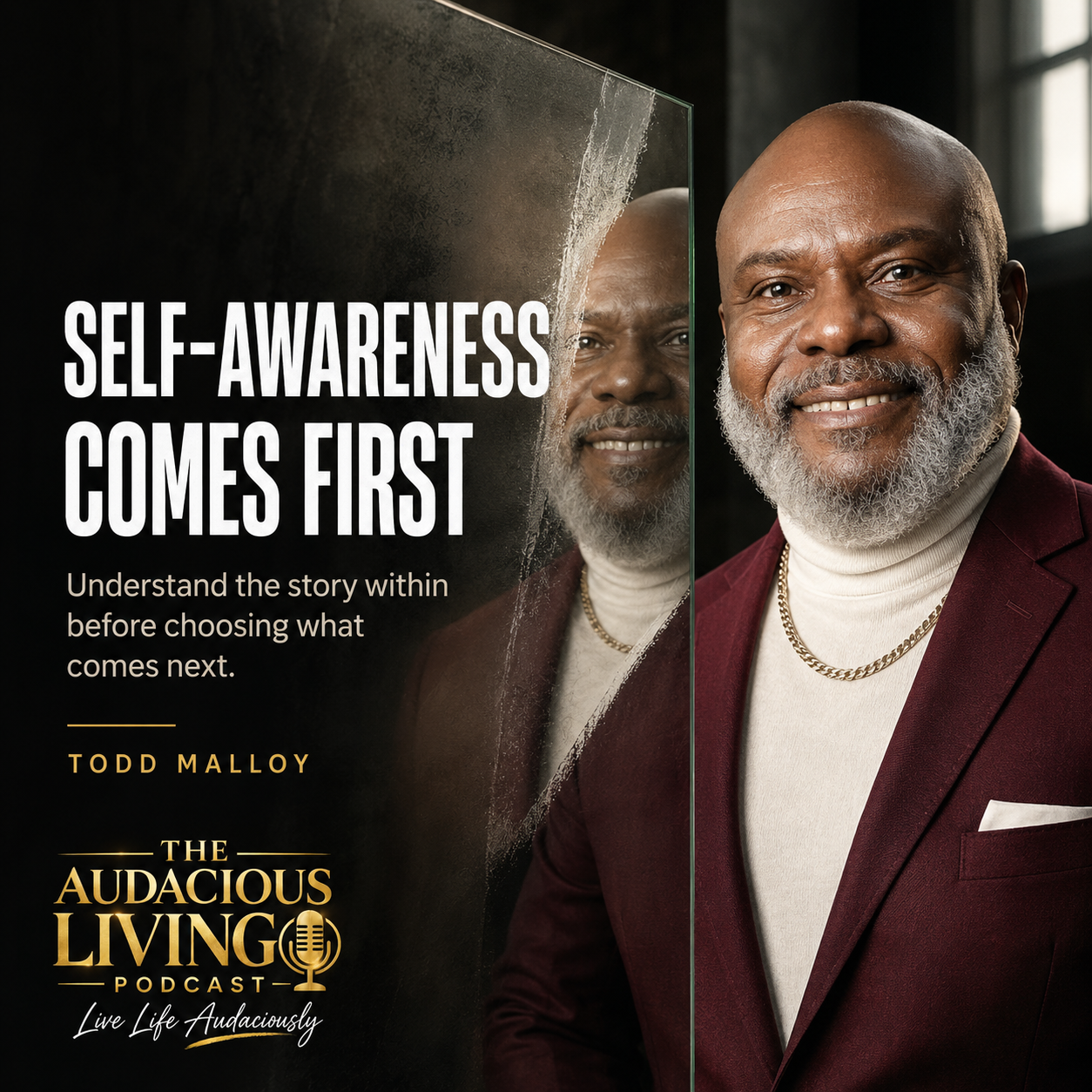
We all carry stories about who we are.
Some are obvious. Others operate so quietly in the background that we rarely think to question them.
Maybe you're the responsible one. The person who holds everything together. The one who never asks for help. Perhaps you've always believed you aren't adventurous, aren't a leader, aren't creative, or simply aren't the kind of person who takes certain risks.
The interesting thing about these stories is that they don't necessarily feel like stories.
They feel like facts.
That's what made my conversation with psychotherapist Todd Malloy so compelling. Todd's work is centred on helping people understand the narratives underneath their behaviour and, as he puts it, helping people “give themselves permission to be.”
That permission begins with self-awareness.
Before we can intentionally decide where we're going, we have to become curious about what's already driving us.
Why This Topic Matters
We tend to associate self-awareness with knowing our personality, strengths, weaknesses or preferences. Those things matter, but Todd's perspective goes deeper.
Self-awareness asks us to examine the internal narrative through which we interpret our lives.
Where did that belief come from?
Why do I react this way?
Is this still true?
Does this behaviour serve the person I am today, or is it serving a version of me that existed years ago?
Todd learned this personally. His father left when he was five, and he took on significant responsibilities while still a child. In therapeutic language, he describes himself as having been a “parentified child,” carrying adult responsibilities long before he was prepared for them.
Those circumstances taught him how to survive. They also shaped behaviours that followed him into adulthood.
Todd eventually recognized that he had become a protector who consistently placed everyone else's needs ahead of his own. Even when his circumstances had changed, part of him was still operating as though the next crisis might be around the corner. His realization was simple but profound: “I'm not where I used to be.”
That's why self-awareness matters.
You can't intentionally change a pattern you haven't recognized as a pattern.
The Stories We Inherit Can Quietly Become Instructions
One of my favourite personal examples is what I call my Sunday shoes.
Growing up, I had shoes reserved for church. Those were the rules. Sunday shoes were worn on Sunday.
Nothing particularly unusual about that.
Except I carried the rule into adulthood.
I eventually found myself in my forties looking at a pair of shoes and wondering why I couldn't wear them on a Tuesday or Thursday.
Nobody was stopping me.
The rule wasn't being enforced.
I was simply following an instruction that had been programmed into me years earlier.
We laughed about the example, but the principle is anything but trivial.
How many Sunday-shoe rules are operating in our lives?
Todd explains that part of his therapeutic work involves asking people to identify the narrative driving them. We inherit definitions of success, relationships, masculinity, responsibility, family and identity. Some remain useful. Others belong to a time, environment or person we've outgrown.
Self-awareness doesn't require us to reject everything we've learned.
It gives us the opportunity to decide what deserves to come with us.
Awareness Lets You Separate the Past From the Present
Knowing that our past influences us is one thing. Seeing precisely how it influences us is something different.
Todd shared a fascinating exercise he has used personally and with others. He described writing down his memories from childhood through age 18, then examining them almost as though he were watching someone else's life unfold on a movie screen.
That distance changed what he could see.
As a child, he didn't have the language or perspective to understand dysfunction, emotional pain or which responsibilities actually belonged to him. Looking back as an adult allowed him to reinterpret those experiences with information his younger self simply didn't possess.
That's an important distinction.
Self-awareness isn't about endlessly reliving the past. It's about understanding how the past may still be influencing the present.
The child who learned that acceptance comes from fixing everyone's problems may become the adult who can't stop rescuing people.
The young person who learned never to show vulnerability may become an adult who struggles to ask for support.
The person who was repeatedly told what they couldn't do may eventually stop questioning those limitations.
Todd made another point that stuck with me: we're often much gentler with other people than we are with ourselves. He encourages people to ask whether they're actually behaving like their own best friend.
Self-awareness allows us to notice that internal voice.
Then we get to decide whether it deserves the microphone.
Knowing Yourself Changes How You Move Through the World
Self-awareness isn't only an internal exercise. It changes how we communicate, establish boundaries and navigate relationships.
Todd's point is straightforward: if I don't understand myself, it becomes difficult to teach someone else how to interact with me.
He knows, for example, how he responds to raised voices. Rather than automatically interpreting someone's intensity as an attack, he can recognize his own reaction, pause and ask for clarity. That awareness gives him another option besides simply reacting.
That's intentional living in practice.
The goal isn't to eliminate emotion.
It's to create enough space between feeling something and responding to it that we can make a choice.
This is where self-awareness becomes empowering.
We begin noticing our triggers without automatically obeying them.
We recognize inherited expectations without automatically accepting them.
We notice the mask we're wearing without assuming we have to keep wearing it.
Todd described freedom as beginning with honesty: honesty with ourselves and honesty with our environment.
You can't have much of either without first paying attention.
Awareness Creates Choice
There is a moment in the conversation that captures the entire idea beautifully.
Todd says:
“Never be upset about awareness.”
I love that.
Because awareness isn't always comfortable.
Sometimes you realize you've been heading in a direction you no longer want to travel.
Sometimes you recognize that a belief you've defended for years isn't actually yours.
Sometimes you discover that the thing you keep blaming on circumstances is something you now have the power to change.
That can sting.
Yet Todd offers another way of looking at it. Discovering that you're heading in the wrong direction isn't bad news. Now you know.
Now you can turn.
His own life illustrates what that can look like.
Todd originally wanted to become a therapist, but he didn't see people who looked like him doing that work and couldn't imagine how he would afford the education. He pursued engineering instead and became successful, earning patents and awards. Yet he knew internally that something didn't fit.
Eventually, he examined the discrepancy between the life he was living and the life he wanted. At 42, he says, he gave himself permission to become who he had wanted to be on the inside.
The career change matters.
The awareness that made the change possible matters even more.
Lessons for Living Audaciously
Living audaciously is often associated with action.
Take the leap. Make the move. Try the thing.
I believe deeply in action, but Todd's story reinforces something that has to come first.
Know what is driving you.
Otherwise, we can move boldly in a direction somebody else chose for us.
Self-awareness asks us to notice the beliefs, expectations, fears and behaviours we've been carrying. Intentionality asks what we want to do with them.
Some deserve to stay.
Some deserve to be updated.
Some deserve to be thanked for getting us this far and then respectfully left behind.
Todd's definition of living audaciously brings the idea full circle. For him, it means living on his own terms, being honest with himself and his environment, and defining his own success.
That doesn't happen accidentally.
It begins with paying attention.
Maybe the first audacious move isn't changing your career, launching the business, leaving your comfort zone or making some enormous declaration.
Maybe it starts much quieter than that.
You notice.
You question.
You understand.
Then, with greater clarity about what's actually yours, you choose.
Conclusion & Call to Action
Todd Malloy's full conversation goes much deeper into identity, childhood conditioning, relationships, career reinvention and the choices that allow us to live more intentionally.
Listen to the full episode of The Audacious Living Podcast, subscribe wherever you listen, follow the show, and if this article brought someone to mind, share it with them.
Sometimes helping someone become more self-aware begins by giving them something worth thinking about.
