
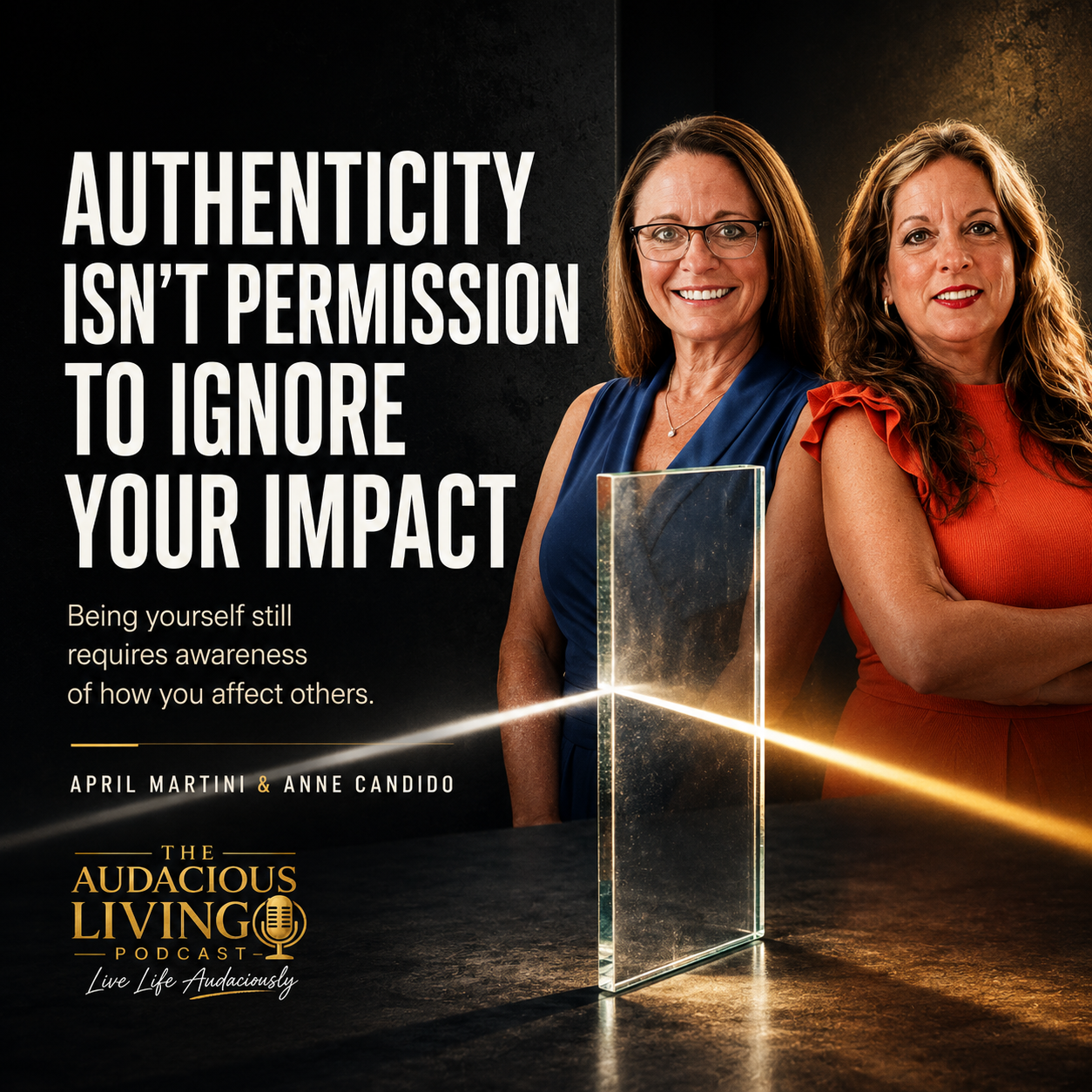
Authenticity Isn't Permission to Ignore Your Impact
“That's just who I am.”
Most of us have heard some version of that statement. Maybe we've even said it ourselves.
Sometimes it's an expression of healthy self-acceptance. We're no longer interested in pretending to be someone we're not or changing ourselves simply to satisfy everyone around us.
There's something freeing about that.
The problem begins when “that's just who I am” becomes the end of the conversation instead of the beginning of greater self-awareness.
Because authenticity doesn't remove responsibility.
That distinction surfaced in my conversation with April Martini and Anne Candido, co-founders of Forthright People. As we explored personal branding and leadership, we landed on a deceptively simple question: If being yourself negatively affects the people around you, is insisting on “being authentic” really enough?
Their answer challenged a common misunderstanding about authenticity.
You don't have to change who you are at your core. You do have to pay attention to how who you are shows up in the world.
Why This Topic Matters
Authenticity has become one of those words we use almost automatically.
Be authentic. Bring your whole self. Speak your truth.
Those ideas can be valuable, particularly in environments where people feel pressure to perform a version of themselves that doesn't feel genuine. Anne described authenticity as the grounding from which we can build. Our characteristics, values, experiences and points of view are part of what makes each of us distinctive. Trying to maintain a persona that isn't really us eventually creates inconsistency.
But there's another side to authenticity that deserves just as much attention.
How we experience ourselves isn't necessarily how other people experience us.
We might describe ourselves as confident while someone else experiences us as dismissive. We may consider ourselves passionate while another person feels overwhelmed. We might pride ourselves on being direct while someone on the receiving end experiences our communication very differently.
Intent matters.
Impact matters too.
That's particularly important in leadership, but it extends far beyond the workplace. It shows up in friendships, families, partnerships and everyday conversations.
Authenticity tells us where we're starting.
Self-awareness helps us decide how we should show up next.
Your Core Doesn't Have to Change
One of the most useful distinctions Anne offered was between our fundamental characteristics and the behaviours through which those characteristics are expressed.
She described our core characteristics as deeply ingrained: our traits, values, experiences and perspectives. Trying to force ourselves into someone else's identity can feel like “white knuckling” our way through life.
Behaviour is different.
How we communicate, respond and present ourselves can be adjusted according to the environment without abandoning who we are.
That's an important distinction.
Adaptability isn't automatically inauthenticity.
Think about how naturally we already understand this in other areas of life. You can be playful without behaving exactly the same way at a funeral as you would at a birthday party. You can be passionate without expressing that passion identically in a one-on-one conversation and in front of a large audience.
The underlying person hasn't disappeared.
The expression has changed because the context changed.
Maturity means recognizing that distinction.
We don't have to abandon our identity to become more effective. Sometimes we simply need a larger range of ways to express it.
Directness Is a Trait, Not a Free Pass
Our discussion became particularly interesting when Anne used directness as an example.
Both Anne and April consider themselves extremely direct. Their company's name, Forthright People, certainly doesn't hide that fact.
Their approach isn't to tell a direct person to stop being direct.
Instead, they encourage that person to consider whether their level of directness was appropriate for what a particular situation required.
That changes the question.
Instead of:
Was I being myself?
We begin asking:
Was the way I expressed myself effective in this situation?
During our conversation, I pushed the example further.
People sometimes defend their behaviour by saying, “I'm just being authentic. I'm direct. That's who I am.”
My response was that delivery still matters because we're communicating with human beings. If my directness consistently leaves people feeling diminished, disrespected or unable to hear what I'm trying to communicate, I have to ask whether I'm actually being effective.
Calling something authenticity doesn't automatically make the behaviour appropriate.
That doesn't mean walking on eggshells or trying to make everyone happy. Leadership will sometimes require difficult conversations, disagreement and uncomfortable truths.
The challenge is learning to communicate those truths without using authenticity as protection from examining our own behaviour.
Intent Doesn't Control How a Message Lands
Here's where the conversation gets uncomfortable.
You can have good intentions and still create a negative impact.
Anne put it plainly: other people's perceptions become their reality. If we're trying to communicate something, we carry some responsibility for whether the message can actually be heard and received.
That doesn't mean we're responsible for every interpretation another person makes.
Communication is a two-way process, and misunderstanding can happen even when we've been thoughtful.
Still, “I didn't mean it that way” can't always be the final answer.
If the same communication problem follows us from meeting to meeting, relationship to relationship or team to team, there may be information in that pattern worth examining.
Anne offered a practical starting point: look back at situations that went well and those that didn't. Pay attention to what was happening around you. Was it the environment? The people? The context? The request being made? Those patterns can reveal situations that trigger certain responses and help us become more intentional about how we show up.
That's self-awareness in action.
Not judgement.
Not beating yourself up.
Information.
And information gives us choices.
Adaptability Can Be an Expression of Authenticity
There can be resistance to all of this because adapting our behaviour sometimes feels like performing.
If I'm changing how I communicate depending on who I'm talking to, am I really being myself?
I think there's a better way to frame it.
Adaptability doesn't require pretending to possess characteristics you don't have. It means learning how to use what you already have more effectively.
Anne illustrated this when discussing people who admire colleagues who are confident presenters or who speak easily during meetings. The answer isn't simply to imitate those people. Instead, we can study what they do and determine which behaviours fit who we are.
Perhaps someone who gets nervous speaking in meetings needs the agenda beforehand, more preparation or a few talking points ready. They're learning from another person's behaviour without trying to become that person.
That's a meaningful difference.
There is no contradiction between authenticity and growth.
You can remain direct and improve your delivery.
You can remain introverted and learn to contribute more confidently.
You can remain decisive while learning to listen longer.
You can remain passionate while becoming more aware of when your intensity overwhelms the room.
The goal isn't to become less yourself.
It's to become more intentional about how yourself shows up.
Lessons for Living Audaciously
Living audaciously requires authenticity.
I've believed that for a long time.
There is tremendous power in understanding who you are instead of constantly looking left and right at somebody else's path. During this conversation, I talked about how easy it is to see what someone else is doing and decide that's what we're supposed to do too. The problem is that their path was designed for them, not necessarily for us.
But owning your identity comes with responsibility.
Real confidence should make us more capable of examining ourselves, not less.
That may mean recognizing that a characteristic we value isn't producing the impact we intended in a particular situation. It may mean listening when someone tells us how our words landed instead of immediately defending what we meant. It may mean adjusting our delivery without believing we've compromised our identity.
There's courage in that.
Anne and April's broader philosophy is that what we need to build upon is already within us. The work is becoming aware of it, refining how we show up and learning how to use those internal tools intentionally.
Authenticity asks us to know ourselves.
Audacity asks us to keep growing once we do.
Conclusion & Call to Action
Being yourself matters.
Learning how your “self” affects the people around you matters too.
That balance between authenticity and awareness is where some of our most meaningful growth can happen.
Listen to the full conversation with Anne Candido and April Martini on The Audacious Living Podcast, subscribe wherever you listen, and if this idea made you reconsider what authenticity really means, share the article or episode with someone who might appreciate the conversation.
