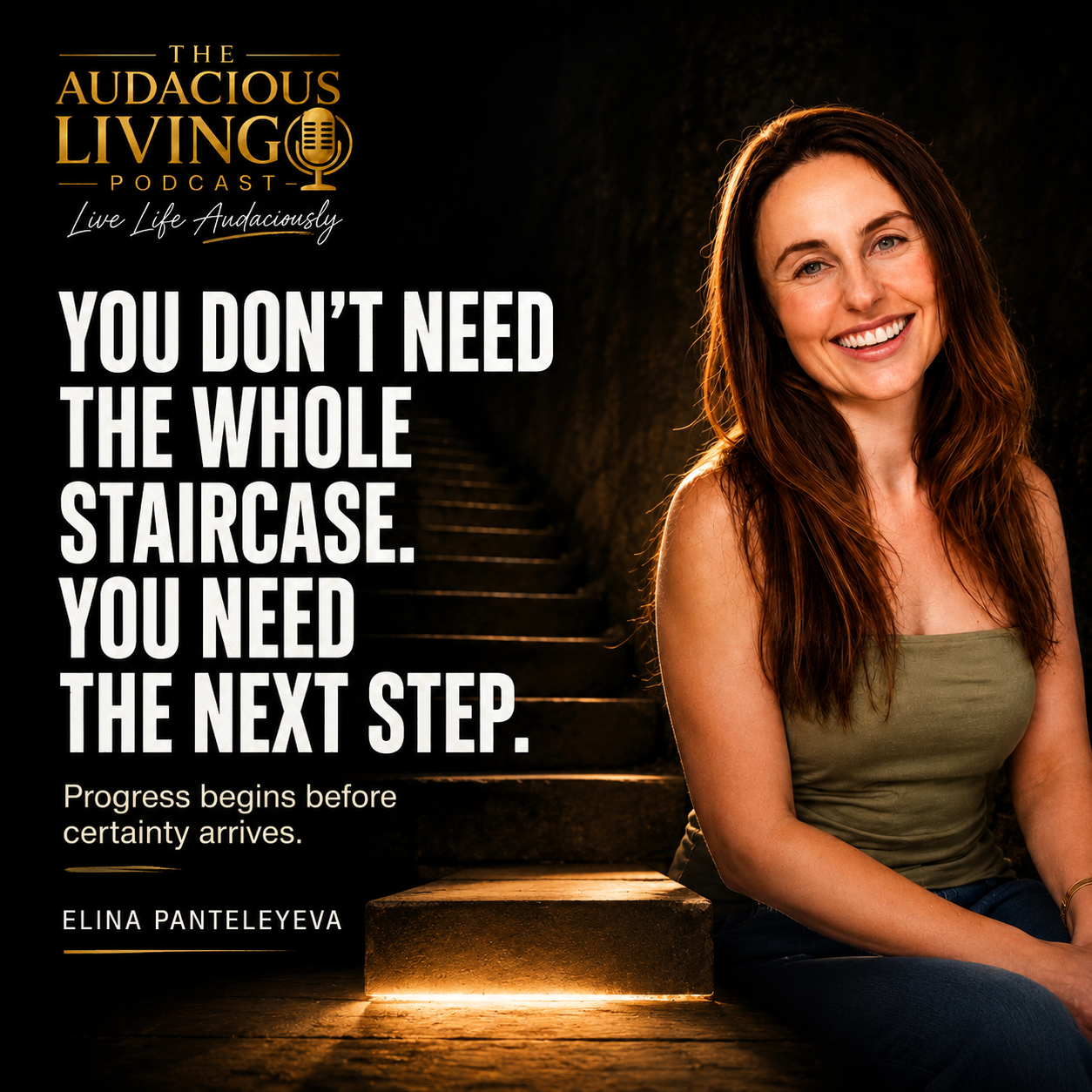
You Don't Need the Whole Staircase. You Need the Next Step.
We have an interesting habit when we face uncertainty: we try to eliminate it before we move.
We want to know whether the idea will work. How long it will take. Whether we're making the right decision. What happens if we fail. What comes after the next decision, and the one after that.
Essentially, we want to see the entire staircase before putting our foot on the first step.
The problem is that life rarely works that way.
Sometimes clarity doesn't come before action. Sometimes action is what creates clarity.
That idea sits at the heart of my conversation with entrepreneur and e-commerce founder Elina Panteleyeva. When Elina was laid off from her tech job in 2023, she didn't have an established business waiting in the wings. She didn't even have a product idea. What she had was an unexpected opening and a willingness to explore what might come next.
She eventually built an e-commerce brand serving doodle owners, but there was no master blueprint showing her exactly how to get there. She started by identifying an audience, listening to its problems and figuring out one problem she might be able to solve.
One step led to another.
That may be one of the most useful ways to think about uncertainty.
Why This Topic Matters
Uncertainty itself isn't always what stops us.
Sometimes it's the demand we place on ourselves to resolve uncertainty before we're willing to act.
Think about how often this shows up in everyday life. Someone wants to change careers, but first they need to know whether the new career will work out. Someone wants to start a business, but they need the complete strategy. Someone wants to write a book, launch a project, return to school or have an important conversation, but their mind immediately races ahead.
What if this happens?
What about that?
Then what?
Before long, one decision has somehow become 10,000 decisions.
Elina described this beautifully when talking about the early stages of building her business. She said the overwhelming part comes when you start thinking “10,000 steps ahead.” Instead, she learned to reduce the problem to what she could actually do that day, even if it was simply filling out a manufacturer's contact form and asking for a meeting.
That's an important distinction.
Thinking ahead is useful. Trying to live every future step simultaneously isn't.
Overwhelm Grows When the Future Becomes Today's Problem
There is nothing wrong with planning.
A plan can give us direction, reveal risks and help us make better decisions. The trouble begins when planning quietly becomes a requirement for certainty.
Elina entered e-commerce without experience in e-commerce or manufacturing. She had previously worked in tech. She also understood that selling a physical product meant putting money into inventory before knowing whether customers would actually buy it.
Those were legitimate risks.
She didn't make them disappear.
Instead, she worked on the next problem she could solve.
First, she needed an audience. She chose doodle owners because she was one herself and felt comfortable creating content with her dog. Then she needed to understand what those owners actually struggled with. Rather than guessing, she entered Facebook groups and spoke directly with people. A recurring problem emerged: doodle hair becomes tangled and matted easily.
Notice what she wasn't doing.
She wasn't solving year five.
She was solving today.
That's a useful question whenever something feels overwhelmingly large:
What part of this actually belongs to today?
Action Creates Information That Thinking Cannot
We often treat action as something that should happen after certainty.
In reality, action frequently produces the information we need to become more certain.
Elina didn't know whether doodle owners were an underserved market. Her response was refreshingly simple: “I didn't know so, and I also didn't want to guess.”
So she asked people.
Later, when she needed a manufacturer capable of helping her develop a natural detangling product, she started searching and contacting companies. Many said no. Some were too expensive. Eventually, deep into the search results, she found someone willing to work with her.
Every action gave her another piece of information.
That's what makes the next step so powerful.
It doesn't have to solve everything. It only has to teach you enough to determine what comes next.
Sometimes the step confirms your direction.
Sometimes it exposes a problem.
Sometimes it tells you to pivot.
All three are progress because you now know something you couldn't have known while standing still.
You Don't Need Confidence Before You Begin
Another trap is believing we should feel confident before doing something unfamiliar.
How could we?
Confidence is often evidence-based. We trust ourselves to do things we've already demonstrated we can do. New territory doesn't provide that evidence yet.
Elina made this point when she talked about the difficulty of starting a business for the first time. Your brain, she explained, has no proof yet that you can do it because you've literally never done it before.
That doesn't mean you're incapable.
It means you're inexperienced.
Those are very different things.
One thing that helped Elina was surrounding herself with other entrepreneurs, including people who were a few steps ahead. During moments when her own confidence disappeared, she could lean on people who saw possibility she couldn't yet see herself.
She described it as “borrowing confidence from other people.” Eventually, that relationship can reverse and someone else begins borrowing confidence from you.
There is something powerful about that.
Sometimes the next step isn't doing something alone.
Sometimes the next step is finding someone who helps you believe that another step exists.
Small Steps Build Evidence
The beautiful thing about taking small steps is that they accumulate.
One action becomes experience.
Experience becomes information.
Information creates better decisions.
Better decisions create momentum.
Eventually, you look behind you and realize you've travelled much farther than any individual step seemed capable of taking you.
Elina's early social-media content wasn't polished. She openly says it was “nothing sexy.” She simply documented the process, learned about building an email list and kept moving. Eventually, the product launch generated enough initial purchases to trigger Amazon's algorithm and become a number-one new release. Her audience later grew to roughly 60,000 across her channels and email list.
The important lesson isn't the size of the audience.
It's how it began.
Elina didn't wait until she could operate like the business she hoped to become.
She operated like the business she could be that day.
There is a tremendous difference.
The Goal Isn't Blind Risk. It's Forward Movement.
Taking the next step doesn't mean abandoning judgment. In fact, Elina offers an important counterbalance to the romantic idea of throwing caution to the wind.
When people ask whether they should quit their jobs to start businesses, her usual answer is no. If someone can begin while remaining employed, she points out that their salary can provide cash flow and reduce the pressure that comes from making decisions in scarcity.
That's important because audacity and recklessness aren't the same thing.
You can move boldly while managing risk.
You can experiment without betting everything.
You can take one meaningful step without pretending you know where step seventeen will lead.
The point isn't to leap blindly.
The point is to stop requiring guarantees that life cannot give you.
Lessons for Living Audaciously
Living audaciously doesn't require having all the answers.
Sometimes it simply requires enough courage to act on the answer you have today.
Elina eventually described her own audacious superpower as trying things when she has “no idea if they're going to work out.”
There is freedom in that mindset.
Not because uncertainty disappears, but because uncertainty no longer gets the final vote.
Maybe you're looking at something right now that feels enormous. A new career. A business. A relationship decision. A creative project. A personal change you've delayed because you can't predict what happens afterward.
You don't need to solve the entire future today.
Ask a smaller question:
What's the next step I can actually take?
Make the call.
Send the message.
Research the program.
Write the first page.
Ask the question.
Test the idea.
Take the meeting.
Then pay attention to what that step teaches you.
You can decide what comes next when you get there.
Keep the Conversation Going
Elina's story is ultimately about more than entrepreneurship. It's about what becomes possible when we stop demanding a complete map before we're willing to move.
Listen to the full conversation with Elina Panteleyeva on The Audacious Living Podcast, subscribe to the show, and share this article or episode with someone who may be standing at the bottom of their own staircase.
They may not need the whole plan.
They may simply need the courage to take the next step.
